The Ultimate Guide to the Top High-Resolution Handheld Inkjet Printers (2026 Edition)
From strict food safety regulations to pharmaceutical tracking requirements, the demand for precise, scannable variable data on product packaging has never been higher. Whether it's a GS1 DataMatrix code on a medical device or a barcode on a shipping carton, if the print quality is poor, scanners can't read it—and that means chargebacks, fines, or even recalls.
High-resolution handheld inkjet printers have become the go-to solution for businesses that need portable, on-demand coding without sacrificing quality. In this guide, we compare the top 3 Bentsai models—the BT-HH6105F, B35, and B85—to help you find the right fit for your production environment. If you want a full range of Bentsai handheld printers, explore the complete product lineup.
Why High-Resolution Matters in Portable Printing?
Higher resolution isn't just about sharper text—it's about operational compliance and efficiency. Here's why it matters:
- Supply Chain Traceability: The FDA's Food Safety Modernization Act (FSMA) Traceability Rule requires manufacturers of foods on the Food Traceability List to maintain traceability lot codes (TLCs) and share records within 24 hours. A scannable, legible barcode is the foundation of that traceability. Poor print quality means scanning errors, delayed tracebacks, and potential regulatory action.
- Packaging Market Growth: The global portable handheld inkjet printer market is projected to grow at a CAGR of 6.84%, reaching $2.06 billion by 2032. As more businesses adopt on-demand coding, the standard for print quality continues to rise.
- Counterfeit Prevention: High-resolution codes with unique serial numbers are harder to replicate. Clear, detailed printing enables authentication at the point of sale or receipt, protecting both brand reputation and consumer safety.
Key Evaluation Criteria
Before diving into specific models, it's worth understanding the features that separate a good handheld printer from a great one:
- DPI (Dots Per Inch): Higher DPI means sharper text and more reliable barcode scanning. 300 DPI is standard for date codes; 600 DPI is recommended for small barcodes or 2D codes where every pixel counts.
- Substrate Compatibility: Not all surfaces are the same. Porous materials like cardboard and wood need water-based ink, while non-porous surfaces like plastic, glass, and metal require solvent-based ink. Make sure your printer can handle your materials. For more on solvent ink compatibility for non-porous surfaces, refer to our ink guide.
- Weight: If your team is carrying the printer for hours, weight matters. Lighter models reduce fatigue and improve productivity.
- Battery Life: Look for 8+ hours of continuous operation to get through a full shift without recharging.
Top 3 Bentsai Handheld Printers Compared
Here's a quick overview of the three models we'll cover in detail:
| Model | Print Height | Resolution | Weight | Price | Best For |
| BT-HH6105F | Up to 12.7mm | 300/600 DPI | 450g | $530 | Small text, barcodes, date codes on varied surfaces |
| B35 | Up to 25.4mm | 300 DPI | 460g | $700 | Logos, QR codes, larger text (1-inch height) |
| B85 | Up to 92mm | 300 DPI | 1.24kg | $2,199 | Large-format markings: pallets, crates, signage |
Bentsai BT-HH6105F
The Lightweight Precision Coder
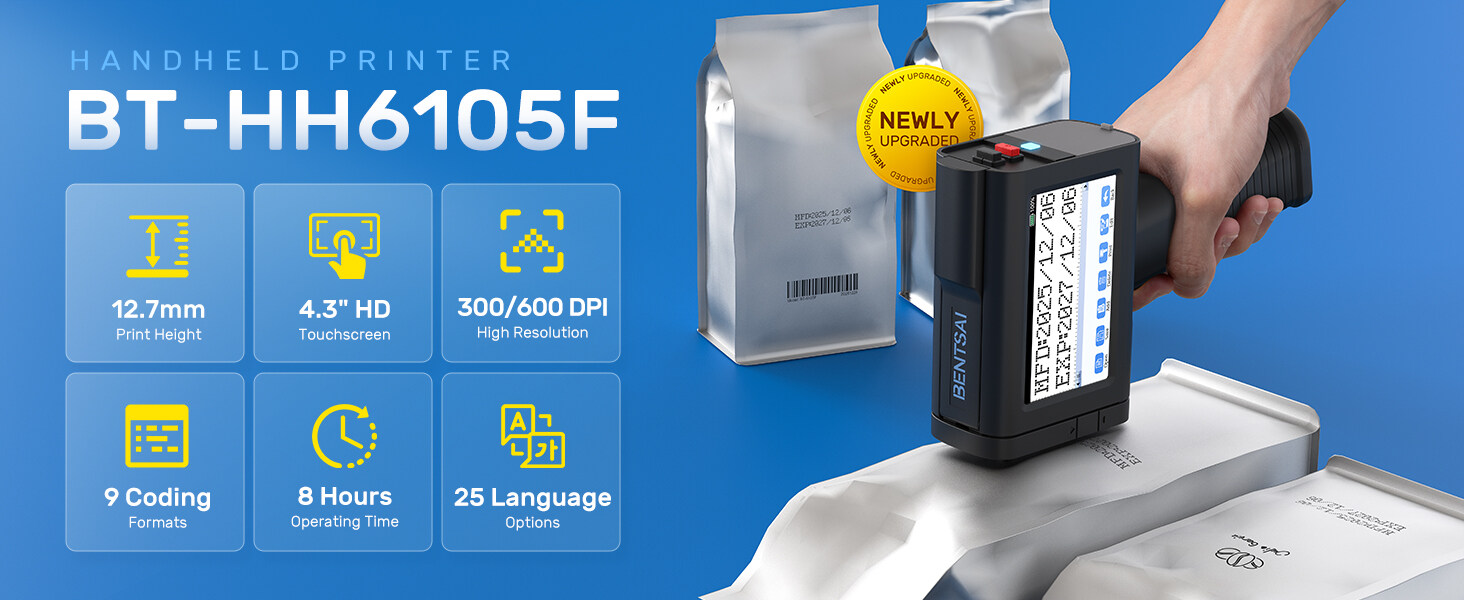
Priced at $530, the BT-HH6105F is Bentsai's entry-level workhorse. Weighing just 450g (about 1 pound), it's designed for operators who need to print small character text, date codes, batch numbers, barcodes, and QR codes on a wide variety of surfaces.
Key Features:
- Adjustable Resolution: Switch between 300 and 600 DPI depending on the job. 600 DPI is ideal for small 2D codes like GS1 DataMatrix.
- Print Height: 2.5mm to 12.7mm (0.1 to 0.5 inches), supporting 1 to 5 lines of text.
- Surface Versatility: Works on porous surfaces (cardboard, wood, fabric) with water-based ink and non-porous surfaces (plastic, glass, metal) with solvent-based ink.
- Battery Life: 8+ hours of continuous use.
- Special Features: Supports variable data printing from USB, ITF-14 and GS1-Datamatrix codes.
Best Applications:
- Printing expiration dates on food and beverage packaging
- Marking part numbers on cables, pipes, and small components
- Retail labeling and event ticketing
Bentsai B35
The Versatile 1-Inch Handheld Printer
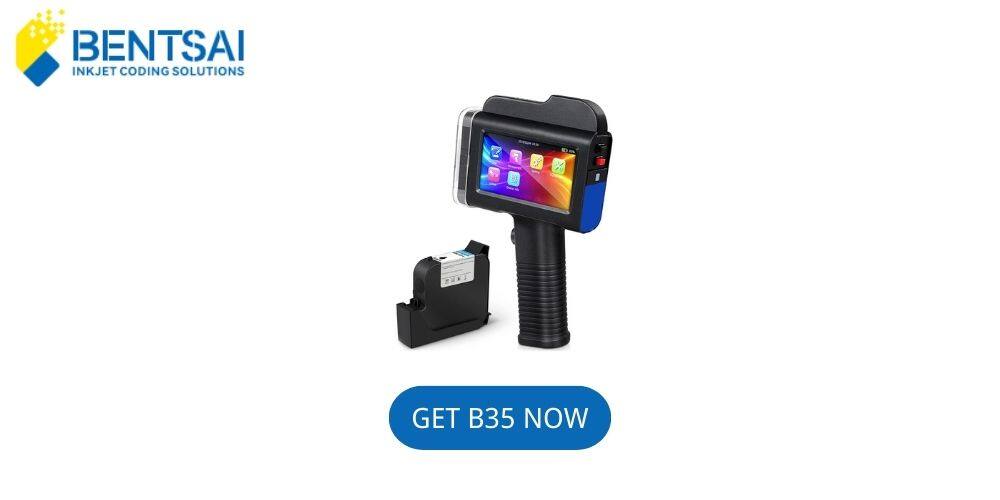
At $700, the Bentsai B35 offers a larger print height of up to 25.4mm (1 inch) while maintaining a lightweight design at just 460g. It supports 1 to 10 lines of text and is ideal for applications that require larger codes, logos, or graphics.
Key Features:
- 1-Inch Print Height: Prints text, barcodes, QR codes, and logos up to 25.4mm tall.
- Variable Data Printing: Supports variable text, QR codes, and barcodes from txt and csv files for batch coding.
- Conveyor Integration: Can be mounted with a photoelectric sensor for automatic inline printing on production lines.
- Print Resolution: 300 DPI.
- Surface Compatibility: Uses both water-based and solvent-based ink cartridges, handling porous and non-porous surfaces.
Best Applications:
- Printing logos, transport information, and barcodes on cardboard boxes
- Marking serial numbers and batch codes on plastic pipes and cables
- Production line automatic coding
Bentsai B85
The 4-Inch Wide Format Powerhouse
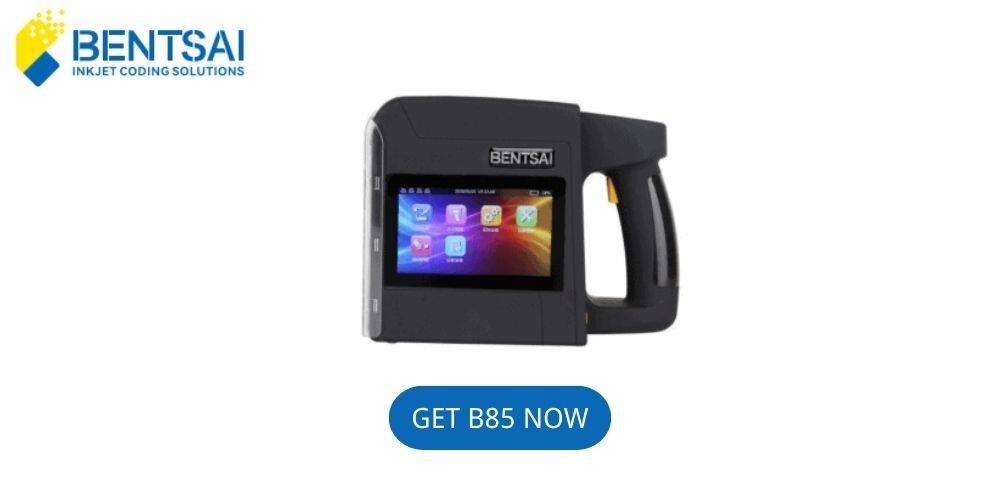
For industrial applications that require large-format printing, the Bentsai B85 delivers up to 92mm of print height at $2,199. It's designed for manufacturing plants, construction sites, timber processing, and logistics operations that need oversized markings.
Key Features:
- Large Print Height: Up to 92mm (adjustable from 2.5mm to 92mm), supporting up to 40 lines of text.
- Four Independent Print Heads: Each print head works independently. You can use one, two, three, or four cartridges depending on the job.
- Extended Battery: 10+ hours of working time.
- Max Print Length: Up to 2100mm (2.1 meters).
- Application: Prints large-format logos, logistics symbols, construction signs, safety warnings, and specifications.
Best Applications:
- Marking wooden crates, timber, and lumber
- Printing safety warnings and construction signage
- Large-scale logistics markings on pallets and shipping containers
Real-World Application Examples Across Industries
- Timber & Construction: The B85 is widely used in timber processing to mark HT (heat-treated) labels, grade stamps, and safety warnings directly on lumber and wooden crates. The large print height ensures markings are visible from a distance.
- Pharmaceutical Packaging: The BT-HH6105F and B35 print high-resolution lot numbers and expiration dates on medicine boxes and bottles, meeting FDA labeling requirements for 21 CFR Part 211. Clear, smudge-proof codes are essential for compliance and patient safety.
- Logistics & Warehousing: Handheld printers generate QR codes and barcodes on shipping boxes at the point of packing. Workers print on site instead of walking to a centralized label station, saving time and reducing errors.
ROI and Total Cost of Ownership
Handheld thermal inkjet (TIJ) printers offer a lower total cost of ownership compared to traditional continuous inkjet (CIJ) systems:
- Equipment Cost: CIJ systems often start at $10,000+; Bentsai handheld printers range from $530 to $2,199.
- Installation: Handheld printers are plug-and-play. No installation fees, no production line downtime for setup.
- Maintenance: CIJ systems require regular maintenance contracts ($1,500–$3,000/year). Handheld TIJ printers require minimal maintenance—just replace ink cartridges as needed.
- Ink Efficiency: A 42ml cartridge prints up to 2,000,000 characters, 98,182 QR codes, or 29,189 barcodes.
For a facility printing 10,000 labels monthly, switching to direct-to-surface printing with a handheld printer eliminates adhesive label costs of $3,600–$8,400 annually.
Frequently Asked Questions
Q1: Does high-resolution printing consume more ink than standard printing?
Yes, but the difference is manageable. Higher DPI prints use more ink per square inch because there are more dots. However, for small text or barcodes, the increased ink usage is minimal. For large-format graphics, you'll notice the difference. Bentsai printers let you toggle between 300 and 600 DPI, so you can use 300 DPI for simple date codes and 600 DPI only when you need the extra detail.
Q2: Do these printers require constant maintenance or printhead cleaning?
No. Bentsai handheld TIJ printers are low-maintenance. The printhead is integrated into the ink cartridge, so when you replace the cartridge, you get a new printhead. The only routine care is to cover the cartridge with the protective cap when the printer is not in use for more than 10 minutes—this prevents ink from drying and clogging the nozzle. No special tools, cleaning kits, or service contracts are required.
About the Author

Matty Chen is an Inkjet Application Engineer, and BENTSAI Inkjet Printing technology Consultant. He specializes in industrial inkjet printing technologies, with a focus on handheld printers, thermal inkjet systems, and coding solutions. His work explores ink performance, material compatibility, and practical printing applications for businesses across manufacturing, packaging, and product customization industries.
Bentsai Handheld Printer Comparison: BT-HH6105B2 vs. BT-HH6105B3, B30 vs. B35, B80 vs. B85
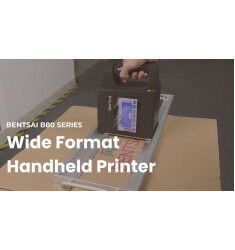
Introducing the Bentsai B80 Series Wide Format Handheld Printer for Large Character Printing
Become a Distributor for Bentsai: Leading in Handheld Printer Innovation
Ask Question
No questions and answers

