What is a Handheld Inkjet Printer? Core Functions & Industrial Applications
A handheld inkjet printer is a portable, battery-operated coding machine used to print variable data—such as barcodes, lot numbers, and expiration dates—directly onto products, packaging, or industrial materials. Unlike fixed printers that require items to be brought to them, handheld models go where the work is.
Businesses switch to a handheld printer to work more efficiently. Handheld printers reduce downtime, eliminate adhesive label costs, and allow on-demand printing of variable data like batch numbers and QR codes. From food packaging lines to warehouse shelves and construction sites, these printers handle materials that traditional label printers cannot.
For industries needing on-the-go coding, a handheld inkjet printer delivers flexibility that stationary systems cannot match.
The 4 Main Functions of Handheld Inkjet Printers
- Date & Batch Coding: Print expiration dates, manufacturing dates, and batch numbers directly on cartons, pouches, or cans. No more pre-printed labels that become obsolete when dates change.
- Traceability & Barcoding: Generate scannable 1D barcodes and 2D QR codes on demand. Link each product to its production data for full supply chain visibility.
- Logo & Branding Application: Add company logos, certification marks, or handling instructions directly onto packaging. No need for custom-printed boxes.
- Variable Data Printing (VDP): Change printed information from one item to the next. Print unique serial numbers, customer-specific codes, or sequential batch IDs without stopping the line.

How They Work: Key Entity Attributes and Capabilities
| Feature | Specification |
| Print Technology | Thermal Inkjet (TIJ) – uses heat to eject ink droplets onto surfaces |
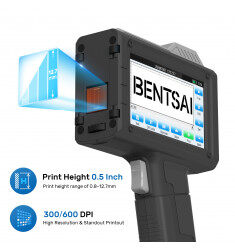
| Resolution | Up to 600 DPI – delivers sharp, scannable barcodes and crisp text |
| Print Height | 0.5 inches (12.7 mm) to 2 inches (50.8 mm) depending on model |
| Ink Compatibility | Water-based (porous surfaces like wood, paper, uncoated cardboard) / Solvent (non-porous surfaces like plastic, glass, metal, coated boxes) |
Practical Application Examples and Industry Data
1. Food & Beverage Packaging: Print best-by dates directly on milk cartons, frozen food boxes, or produce bags. Eliminates label peeling caused by condensation.
2. Logistics & Warehousing: Mark shipping boxes with tracking barcodes and handling instructions. Workers print on site instead of walking to a centralized label station.
3. Manufacturing & Automotive: Print part numbers, batch codes, or QR codes on metal brackets, plastic housings, and rubber seals. Marks survive heat, oil, and abrasion.
4. Wood Processing: Stamp grade stamps, moisture content, or mill information directly on lumber. Water-based inks absorb into wood without smudging.
For more detailed applications, read Knowledge 101: Different Uses of Handheld Inkjet Printer.
Handheld vs. Traditional Inline Printers: A Quick Comparison
| Factor | Handheld Inkjet Printer | Traditional Inline Printer |
| Mobility | Portable, use anywhere | Fixed to production line |
| Cost Efficiency | Low entry cost, no label stock | High equipment cost + consumables |
| Setup Speed | Minutes, no tools required | Hours or days, requires installation |
| Best For | Short runs, variable data, multiple lines | High-volume, single-product lines |
Frequently Asked Questions
How long does a handheld printer ink cartridge last?
A standard 42ml cartridge prints approximately 500,000 characters (roughly 3,000-5,000 barcodes or 10,000 date codes). Actual yield depends on print coverage and image density.
Can a handheld inkjet printer print on curved surfaces?
Yes. Most handheld printers print on curved surfaces up to 6 inches in diameter. The print head maintains consistent distance when you follow the curve. For bottles or pipes, solvent-based inks provide better adhesion than water-based.
What is the difference between water-based and solvent inks?
- Water-based inks: Absorb into porous surfaces like paper, wood, and uncoated cardboard. Eco-friendly, low odor, and economical. Not recommended for plastic, metal, or glossy coatings.
- Solvent inks: Bond to non-porous surfaces like plastic, glass, metal, and coated boxes. Dry in seconds, resist smudging and moisture. Required for challenging industrial environments.

This guide gives you the core functions and industrial applications of handheld inkjet printers. For specific recommendations based on your material and coding needs, reach out with your application details.
About the Author

Matty Chen is an Inkjet Application Engineer, and BENTSAI Inkjet Printing technology Consultant. He specializes in industrial inkjet printing technologies, with a focus on handheld printers, thermal inkjet systems, and coding solutions. His work explores ink performance, material compatibility, and practical printing applications for businesses across manufacturing, packaging, and product customization industries.

The Ultimate Handheld Printer Buying Guide: 10 Essential Factors to Consider (2026)
Ask Question
No questions and answers

