How Much Does a Handheld Printer Cost? (2026 Price & TCO Guide)
How much does a handheld inkjet printer cost? Between $530 and $2,199 for industrial-grade thermal inkjet (TIJ) models, depending on print height, ink system, and features. Here's what drives the price:
| Entity Attribute | Specification / Parameter | Impact on Price |
| Device Type | Handheld TIJ (thermal inkjet) | Entry-level models start lower; wide-format commands premium |
| Print Height | 12.7mm vs. 25.4mm vs. 92mm | Larger print height = higher cost (more printheads, more hardware) |
| Ink System | Water-based vs. solvent-based | Both available; no price difference at hardware level, but ink cost per print varies |
| Print Resolution | 300 DPI vs. 600 DPI | 600 DPI models are priced higher for precision applications |
| Substrate Compatibility | Porous only vs. porous + non-porous | Multi-surface support adds flexibility and value |
| Connectivity | USB only vs. USB + sensor port + Wi-Fi | More connectivity options = higher price |
For a full range of handheld printers, explore Bentsai's industrial coding lineup.
Quick Cost Summary: Handheld Printer Price Tiers
| Category | Price Range | Print Height | Primary Substrates | Target User |
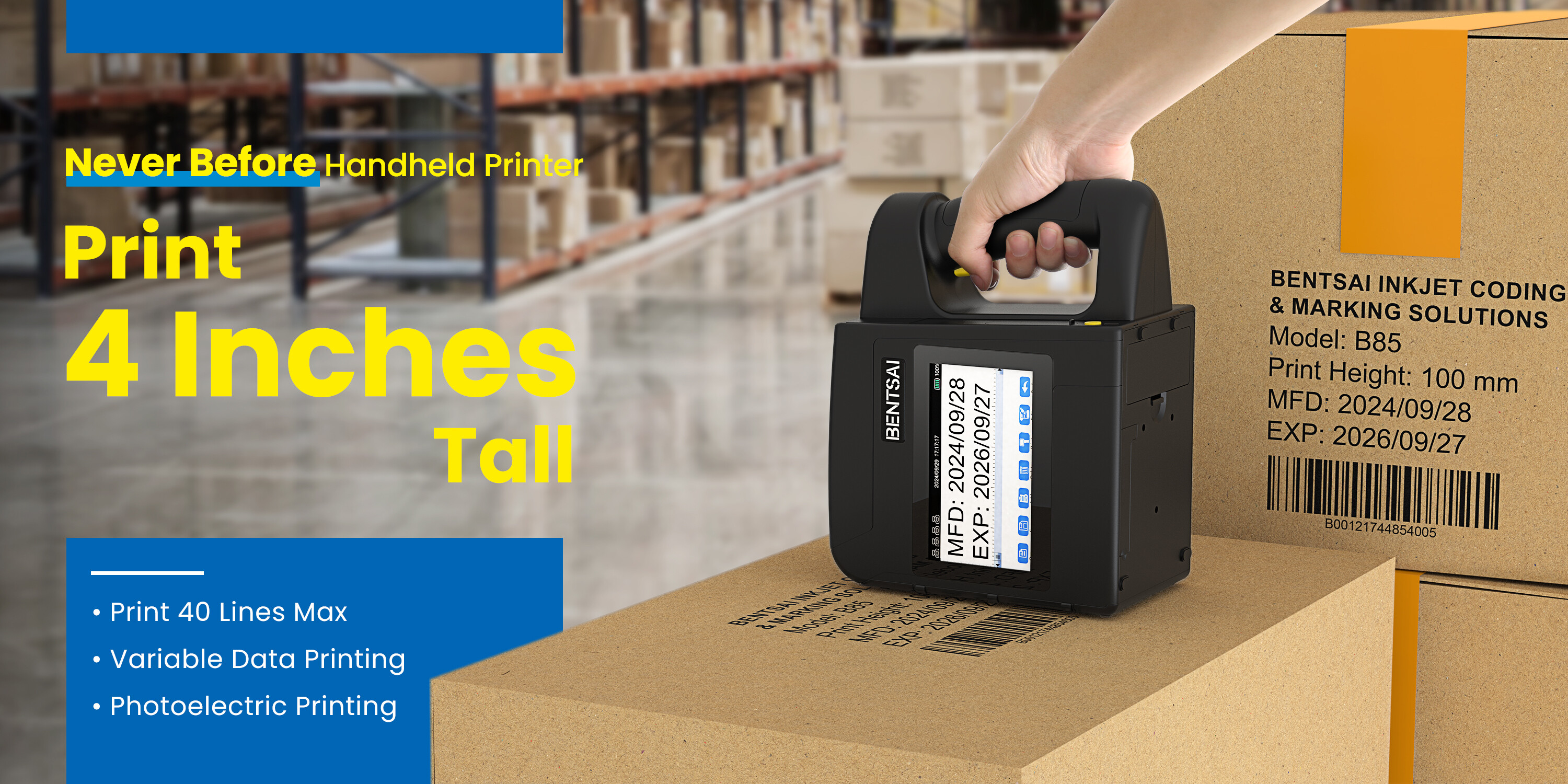
| Entry-Level / Mini | $530 | Up to 12.7mm (0.5") | Cardboard, wood, plastic, metal | Small businesses, light-duty coding |
| Mid-Range | $700 – $1,200 | Up to 25.4mm (1") | Cardboard, wood, plastic, glass, metal | Growing operations, multi-surface needs |
| Wide-Format / Industrial | $2,199 – $3,000+ | Up to 92mm (3.6") | All surfaces, large-scale marking | Heavy industry, logistics, construction |
Note: Prices shown are direct-from-manufacturer (Bentsai) or retail. Third-party resellers may offer different pricing.
Key Factors Influencing Handheld Inkjet Printer Pricing
1. Print Height & Printhead Configuration
Print height is the single biggest price differentiator. More print height requires more hardware:
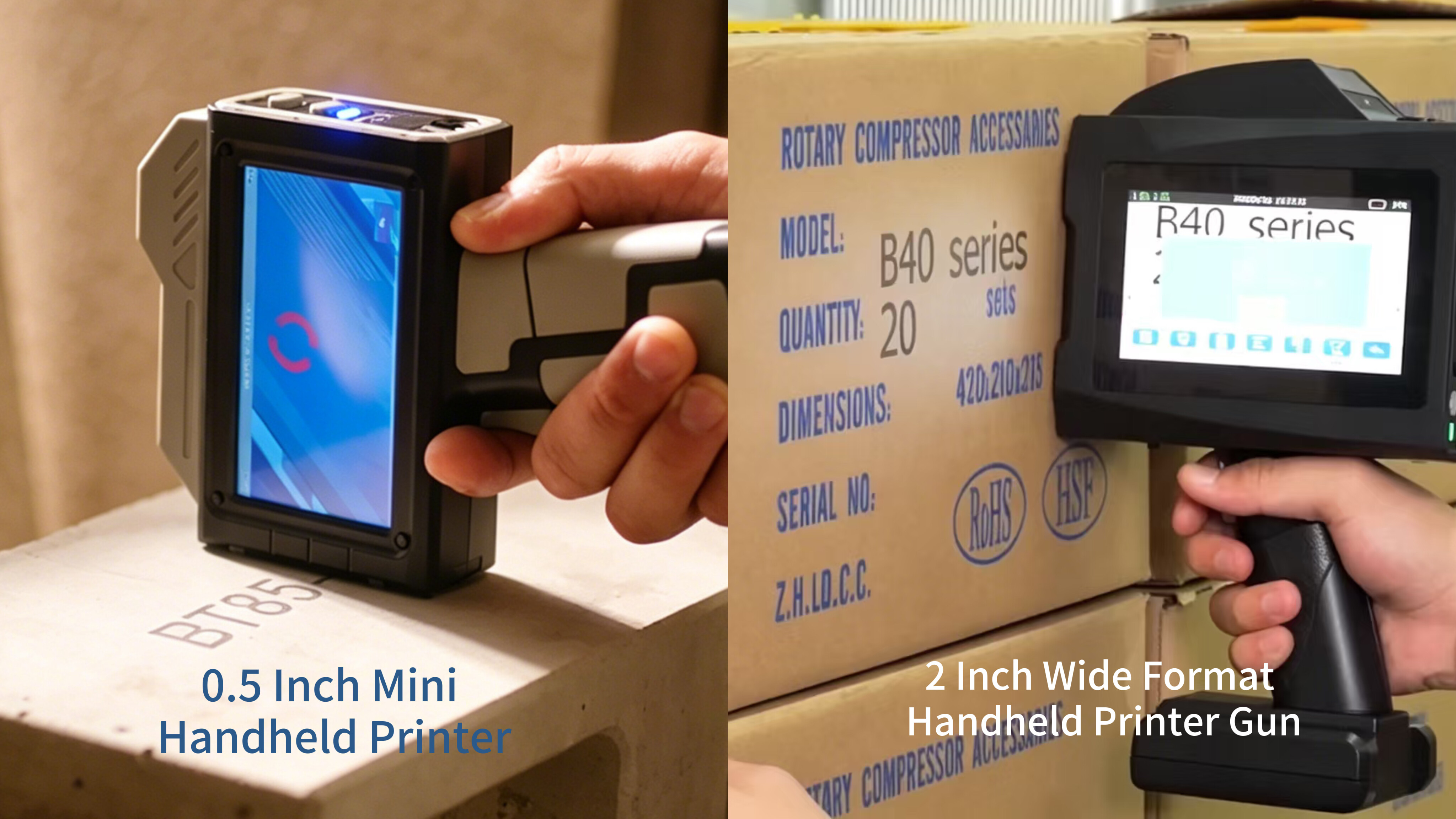
- 0.5-inch (12.7mm) models: Single printhead; compact and lightweight. Ideal for date codes, small barcodes, and text. Example: BT-HH6105F at $530.
- 1-inch (25.4mm) models: Single or dual printhead configuration; supports logos, QR codes, and multiple lines. Example: B35 at $700.
- 4-inch (92mm) models: Four independent printheads; supports large-format logos, safety warnings, and pallet marking. Example: B85 at $2,199.
2. Ink Technology: Water-Based vs. Quick-Dry Solvent Ink Cartridges
The printer hardware costs the same regardless of ink type, but the cost per print differs:
- Water-based ink: Lower cost per cartridge; works on porous surfaces (cardboard, wood, paper). Economical for high-volume packaging.
- Solvent-based ink: Higher cartridge cost; works on non-porous surfaces (plastic, glass, metal, coated packaging). Dries faster and resists moisture.
Each 42ml cartridge prints approximately 2,000,000 characters at 2.5mm print height. This translates to thousands of date codes or barcodes per cartridge.
3. Surface Compatibility & Substrate Versatility
Printers that support both porous and non-porous surfaces offer better value because one device handles multiple production lines. All Bentsai models support both ink types—the hardware is identical; you simply swap cartridges. This eliminates the need for separate printers for different materials.
4. Industrial Features
Additional features add cost but improve efficiency and automation:
- Variable Data Printing: Print unique batch numbers, serial codes, or QR codes from USB-loaded files.
- Barcode Scanning: B71XS models include an integrated scanner to reproduce existing codes.
- Photoelectric Auto-Sensors: Mount the printer on a bracket with a sensor for automatic conveyor belt printing. Reduces manual intervention.
Total Cost of Ownership (TCO): Hardware vs. Consumables
Estimating Cost Per Print (CPP) for Date & Batch Coding
Using Bentsai's 42ml cartridges (approximately 2,000,000 characters per cartridge), here's the estimated cost per print:
| Print Type | Estimated Prints per Cartridge | Cartridge Cost | Cost Per Print |
| Simple date code (2.5mm text) | 2,000,000 characters (~200,000 codes) | $140 | ~$0.0007 |
| Barcode (1" x 1") | ~5,000 – 10,000 codes | $140 | ~$0.014 – $0.028 |
| QR Code (1" x 1") | ~5,000 – 10,000 codes | $140 | ~$0.014 – $0.028 |
Actual yield depends on print size, density, and coverage.
Maintenance & Battery Replacement Lifecycle
- Maintenance: Near-zero. The printhead is integrated into each cartridge—replace the cartridge when ink runs out and get a new printhead. No pumps, filters, or solvents to maintain.
- Battery replacement: Bentsai printers use 6000mAh lithium-ion batteries. Expect 3–5 years of service life with regular use. Replacement batteries are available from Bentsai at approximately $50–$80.
Industry Application Examples and Real-World Cost ROI
Case 1: Food & Beverage Packaging Batch & Expiration Coding
Scenario: A mid-sized food manufacturer prints expiration dates and batch codes on 5,000 boxes per day.
Cost Before: Pre-printed boxes with date codes require ordering in minimum quantities. When dates change, old packaging becomes waste.
- Pre-printed box cost: +$0.08 per box
- Waste rate: 5% from date changes
Cost After: Handheld printer + ink. Print dates on demand. Zero packaging waste.
- Hardware: $700 (B35)
- Ink: $220 per cartridge (~1 month supply)
- Annual savings vs. pre-printed: ~$10,000 – $15,000
For reliable expiry date code printers, Bentsai offers models suited for food packaging.
Case 2: Logistics & Warehouse Outer Carton Labeling
Scenario: A logistics company processes 1,000 outgoing shipments daily. Each box requires a barcode label.
Cost Before: Adhesive labels + label printer + label rolls + labor to peel and apply.
- Label cost: $0.03 – $0.07 each
- Monthly label spend: $900 – $2,100 (10,000 labels/month)
Cost After: Handheld printer + solvent ink. Print barcodes directly on boxes. No labels, no peeling.
- Hardware: $530 (BT-HH6105F)
- Ink: $220 per cartridge (~2-3 weeks supply)
- Annual savings: $3,600 – $8,400 in label costs alone
Case 3: Construction & Pipe/Lumber Marking
Scenario: A construction supplier marks grade stamps, production dates, and quality certifications on lumber and PVC pipes.
Cost Before: Pre-printed tags + staples + labor to attach. Tags fall off or fade outdoors.
Cost After: Handheld printer with solvent-based ink. Print directly on materials. Marks survive weather and handling.
- Hardware: $2,199 (B85 wide-format)
- Ink: Solvent-based for non-porous surfaces
- ROI: Eliminates tag costs, reduces rework from unreadable marks, improves traceability compliance.
Frequently Asked Questions
Q1: How much does it cost to print a single barcode or date code?
Using Bentsai's 42ml cartridges (≈2,000,000 characters), the cost per code is minimal:
| Print Mode | Density | Yield per Cartridge | Cost Per Print |
| Small date code (2.5mm text) | Low | ~200,000 codes | ~$0.001 |
| Barcode / QR Code (1" x 1") | Medium | ~5,000 – 10,000 codes | ~$0.02 – $0.04 |
| Large logo (4" x 4") | High | ~500 – 1,000 prints | ~$0.22 – $0.44 |
Assumes $220/cartridge for solvent ink. Water-based ink is less expensive (~$150–$180/cartridge) but yields similar character counts.
Q2: Are there hidden maintenance costs with handheld inkjet printers?
No. Bentsai handheld TIJ printers have minimal maintenance costs:
- No service contracts: Unlike CIJ systems ($1,500–$3,000/year), TIJ printers require no professional maintenance.
- No solvents or cleaning fluids: The printhead is in the cartridge; replace it when ink runs out.
- No installation fees: Plug-and-play operation; no setup costs.
- Battery replacement: After 3–5 years of use, a replacement battery costs approximately $50–$80.
The only ongoing cost is ink cartridges. If you're printing on porous surfaces, water-based ink is more economical. For non-porous surfaces, solvent ink costs slightly more but delivers durable, smudge-proof marks.
About the Author

Matty Chen is an Inkjet Application Engineer, and BENTSAI Inkjet Printing technology Consultant. He specializes in industrial inkjet printing technologies, with a focus on handheld printers, thermal inkjet systems, and coding solutions. His work explores ink performance, material compatibility, and practical printing applications for businesses across manufacturing, packaging, and product customization industries.

The Ultimate Handheld Printer Buying Guide: 10 Essential Factors to Consider (2026)
The Future of Handheld Printers: 2026 Trends & Industrial Applications
Ask Question
No questions and answers

