What Makes Handheld Inkjet Printers Special: Features, Uses & ROI
Handheld inkjet printers are portable coding devices that deliver industrial-grade marking anywhere.
Function: Battery-powered printers that apply barcodes, dates, text, and logos directly on products and packaging—no fixed installation needed.
Use: Perfect for warehouses, production lines, and field work. Print on cardboard, wood, plastic, glass, and metal with the right ink.
ROI: Cut label costs, slash downtime, and eliminate pre-printed packaging waste. Fast payback, minimal maintenance.
Unique Advantages of Handheld Inkjet Printers
Portability and Ergonomic Design
The defining advantage of handheld inkjet printers is mobility. Weighing as little as 450g (about 1 pound), these devices free operators from fixed printing stations. Workers can carry them anywhere—across warehouse floors, between production lines, or to temporary job sites. This eliminates the time wasted walking back and forth to a centralized printer.
The ergonomic handle is designed for extended use, reducing hand strain during long shifts. The angled grip and balanced weight distribution make one-handed operation comfortable, even when printing on vertical or overhead surfaces. Combined with an intuitive touchscreen interface, operators can navigate settings, select templates, and adjust print jobs without setting the printer down. The result: less fatigue, faster throughput, and happier workers.
Versatile Substrate Printing
Handheld inkjet printers work on nearly any surface—cardboard, wood, plastic, glass, metal, fabric, and even concrete. The secret lies in the ink:
- Water-based ink absorbs into porous surfaces like cardboard, paper, and untreated wood. It's economical, low-odor, and food-safe for external packaging.
- Solvent-based ink bonds to non-porous surfaces like plastic, glass, and metal. It dries in seconds, resists moisture and abrasion, and delivers durable marks that survive handling and shipping.
This versatility makes a single printer useful across multiple production lines, materials, and product types.
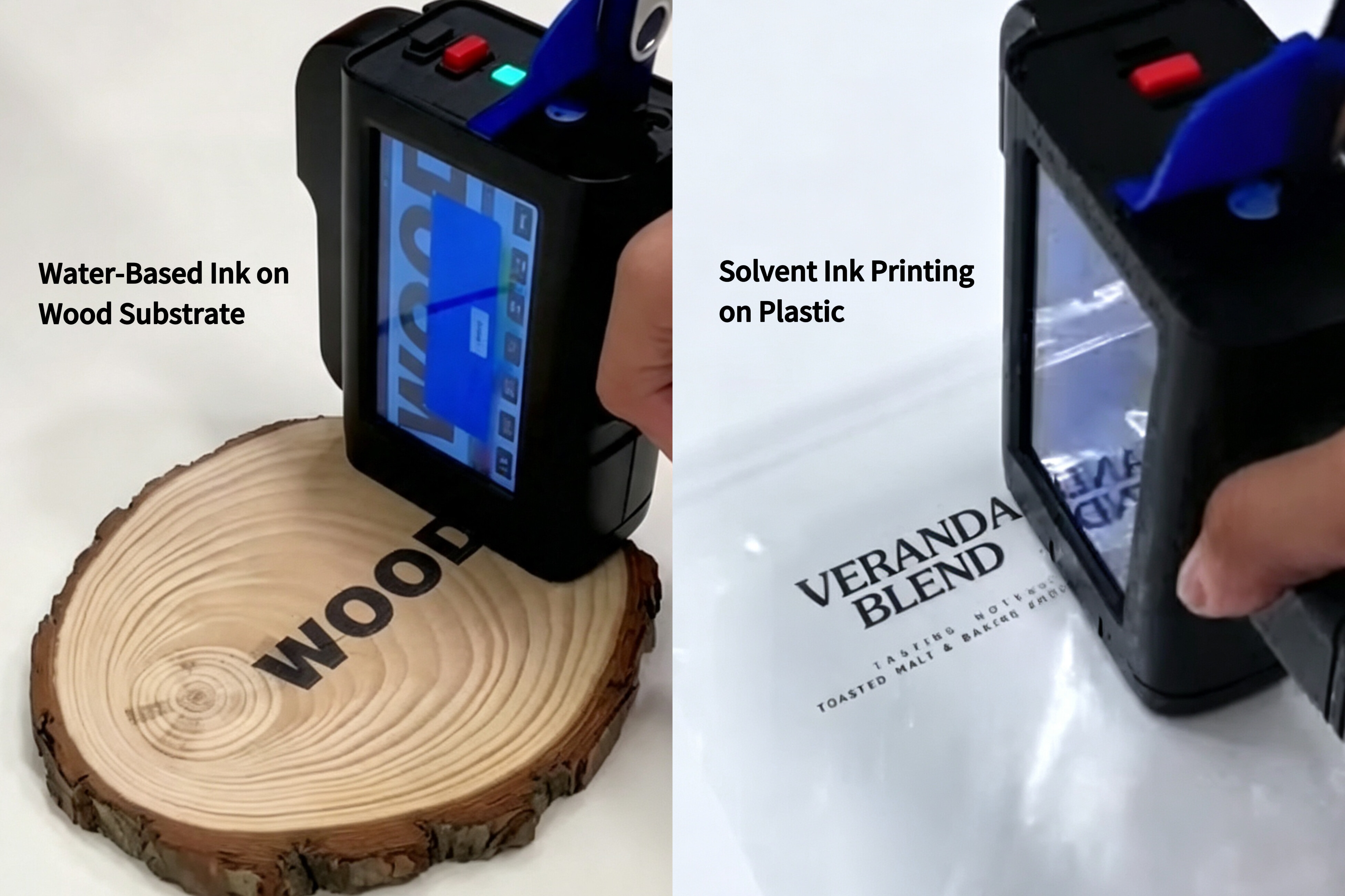
For more details on fast-drying solvent ink cartridges, see our ink selection guide.
High-Resolution Digital Marking
Handheld TIJ printers deliver 300 to 600 DPI resolution—comparable to desktop printers. This means:
- Crisp, readable text even at small sizes
- Scannable barcodes and QR codes that work on the first scan
- Detailed logos and graphics without pixelation
- Compliance with GS1, FDA, and UDI standards that require machine-readable codes
High-resolution marking isn't just about aesthetics—it's about functionality. A barcode that doesn't scan causes chargebacks, returns, and operational delays. Handheld TIJ printers eliminate that risk.
Handheld Inkjet Printers vs. Traditional Line Coders: Comparison
| Factor | Handheld Inkjet Printer | Traditional Line Coder (CIJ/Label) |
| Cost | Low entry cost ($420–$2,199) | High equipment cost ($10,000+ for CIJ) plus ongoing labels |
| Setup Time | Minutes—unbox and start | Hours or days—requires installation and calibration |
| Portability | Fully portable; use anywhere | Fixed to one location |
| Maintenance | Minimal—replace cartridge only | Regular service contracts, pumps, solvents |
| Flexibility | Print multiple surfaces; change codes instantly | Limited to one line/material; batch changes require setup |
The cost per print may be higher for TIJ than CIJ at very high volumes, but for most production environments—especially multi-line, seasonal, or small-batch operations—the total cost of ownership is significantly lower.
Industry Applications and Real-World Case Studies
Packaging & Warehousing Logistics
Handheld printers generate barcodes, QR codes, and shipping data directly on corrugated boxes at the point of packing. No pre-printed labels, no walking to a central printer. Workers print batch numbers, tracking codes, and handling instructions on demand. This reduces errors, speeds up shipping, and eliminates label waste.
Example use: A logistics company prints GS1-compliant QR codes on pallet labels for real-time inventory tracking. Codes encode product IDs, quantities, and destination data—all scannable by warehouse automation systems.
Construction & Pipe Manufacturing
Construction materials—lumber, PVC pipes, concrete blocks, and steel beams—require durable marks that survive outdoor storage and handling. Handheld printers with solvent-based inks apply grade stamps, safety warnings, and production dates directly on rough surfaces.
Example use: A pipe manufacturer marks batch numbers and quality certifications on PVC pipes. The solvent ink bonds to the plastic and resists moisture and UV exposure, ensuring traceability from factory to installation site.
Food, Beverage & Pharmaceuticals
Handheld TIJ printers print expiration dates, batch codes, and lot numbers directly on food boxes, beverage cans, and pharmaceutical packaging. Water-based inks are food-safe for external packaging; solvent inks work on coated materials and plastic bottles.
Example use: A food manufacturer uses a handheld printer to mark FSMA 204 traceability lot codes on outgoing shipments. The QR codes encode batch information and production dates, enabling rapid 24-hour traceback during recalls.
How to Choose the Right Handheld Inkjet Printer
Selecting the right model depends on your specific production needs:
- Print Height Needs: For small text and barcodes under 12.7mm (0.5 inches), compact models like the BT-HH6105F work well. For larger logos or wide-format marks up to 25.4mm (1 inch) or 92mm (3.6 inches), consider the B35 or B85 wide-format printers.
- Substrate Material Assessment: Porous surfaces (cardboard, wood, paper) require water-based ink. Non-porous surfaces (plastic, glass, metal, coated packaging) need solvent-based fast-dry ink. Choose a printer that supports the ink type your materials demand.
- Environmental Factors: Consider operating conditions: humidity, temperature, dust, and exposure to moisture. Solvent inks perform better in damp or variable environments. For harsh industrial settings, select a printer with a rugged build and sealed cartridge design.
For applications needing wide format handheld printers, Bentsai offers models with print heights up to 92mm, supporting large logos and high-visibility case coding.
Frequently Asked Questions
Q1: Can handheld inkjet printers print on plastic and metal?
Yes. With fast-dry solvent ink, handheld TIJ printers adhere to plastic, glass, metal, and coated surfaces. The ink dries in 2–5 seconds and resists smudging, moisture, and abrasion. For best results, ensure the surface is clean and free of oil or dust before printing.
Q2: How long does handheld printer ink take to dry?
Drying time depends on the ink type and substrate:
- Water-based ink on porous surfaces (cardboard, wood): 1–3 seconds
- Solvent-based ink on non-porous surfaces (plastic, metal, glass): 2–5 seconds
Fast-dry formulations ensure codes remain legible immediately after printing, even on high-speed production lines.
Q3: What is the maintenance required for TIJ handheld printers?
Minimal. The printhead is integrated into each ink cartridge. When the ink runs out, you replace the entire cartridge—and get a new printhead each time. No pumps, no filters, no solvents to top up. The only routine care is to cover the cartridge with the protective cap when the printer is not in use for more than 10 minutes to prevent ink from drying and clogging the nozzle.
About the Author

Matty Chen is an Inkjet Application Engineer, and BENTSAI Inkjet Printing technology Consultant. He specializes in industrial inkjet printing technologies, with a focus on handheld printers, thermal inkjet systems, and coding solutions. His work explores ink performance, material compatibility, and practical printing applications for businesses across manufacturing, packaging, and product customization industries.
What is a Handheld Inkjet Printer? Core Functions & Industrial Applications
Ask Question
No questions and answers

