Industrial Date Coding with Handheld Inkjet Printers: Industry Applications & Regulatory Guide
Industrial date coding is the process of marking date-related information—manufacturing dates, expiration dates, and batch numbers—directly onto products or packaging. It ensures product freshness, supports inventory rotation, and enables rapid traceability during recalls. For food, pharma, and manufacturing industries, clear, permanent date codes are not optional; they are regulatory requirements.
Key Takeaways:
- Handheld TIJ printers use heat to eject ink droplets, delivering high-resolution codes without the mess and maintenance of continuous inkjet systems.
- They support variable data—batch numbers, expiration dates, serial codes—uploaded via USB or pre-loaded templates.
- From FSMA 204 food traceability to EU MDR and UDI medical device compliance, handheld date coders help meet regulatory requirements across industries.
What is a Handheld Date Coder and How Does Thermal Inkjet (TIJ) Work?
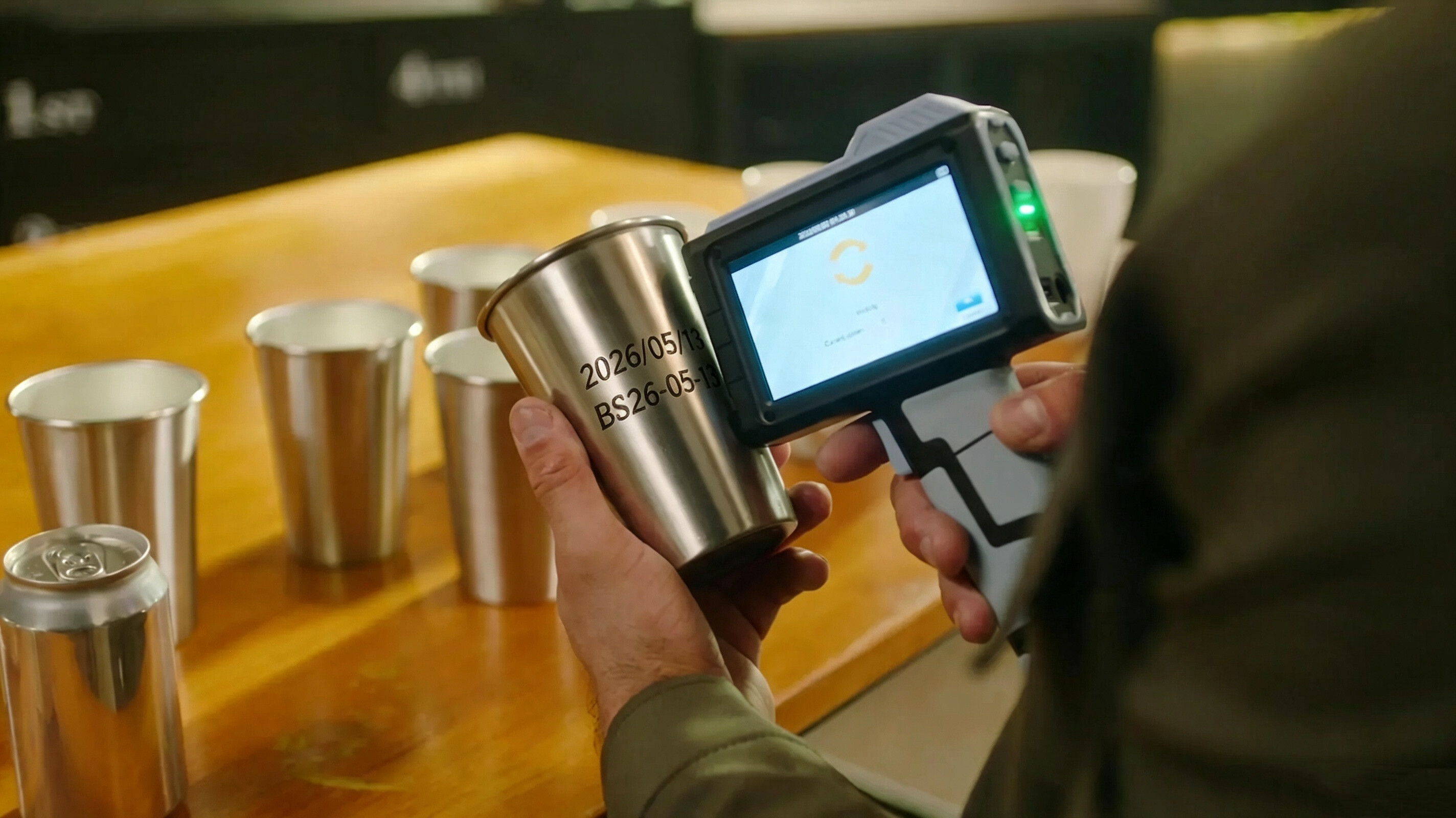
A handheld date coder is a battery-powered industrial printer that uses thermal inkjet (TIJ) technology to mark variable data directly onto products and packaging. Unlike traditional coding systems that are fixed in place, handheld coders go where the work is—making them ideal for multi-line production, seasonal runs, and remote operations.
How TIJ works:
- Heat-ejected droplets: Tiny resistors inside the printhead heat up to over 300°C in microseconds, creating vapor bubbles that force ink droplets out through microscopic nozzles. This "drop-on-demand" process prints only when needed, unlike continuous inkjet systems that waste ink.
- Zero-maintenance cartridges: The printhead is built into each ink cartridge. When the ink runs out, you replace the entire cartridge—no pumps to clean, no solvents to top up, no service contracts. This design, which Bentsai has advanced through its own MEMS-based printhead manufacturing, keeps maintenance minimal and predictable.
- Variable data automation: Load batch numbers, expiration dates, or serial codes via USB drive or pre-saved templates. The printer updates codes automatically with each job, eliminating manual entry errors and ensuring every mark is traceable.
Key Industry Applications and Regulatory Date Coding Requirements
1. Food & Beverage: FSMA Compliance & Expiration Date Coding
The FDA's Food Safety Modernization Act (FSMA) Section 204 requires businesses handling foods on the Food Traceability List (FTL) to maintain Traceability Lot Codes (TLCs) and share records within 24 hours of an FDA request. The compliance deadline is July 20, 2028.
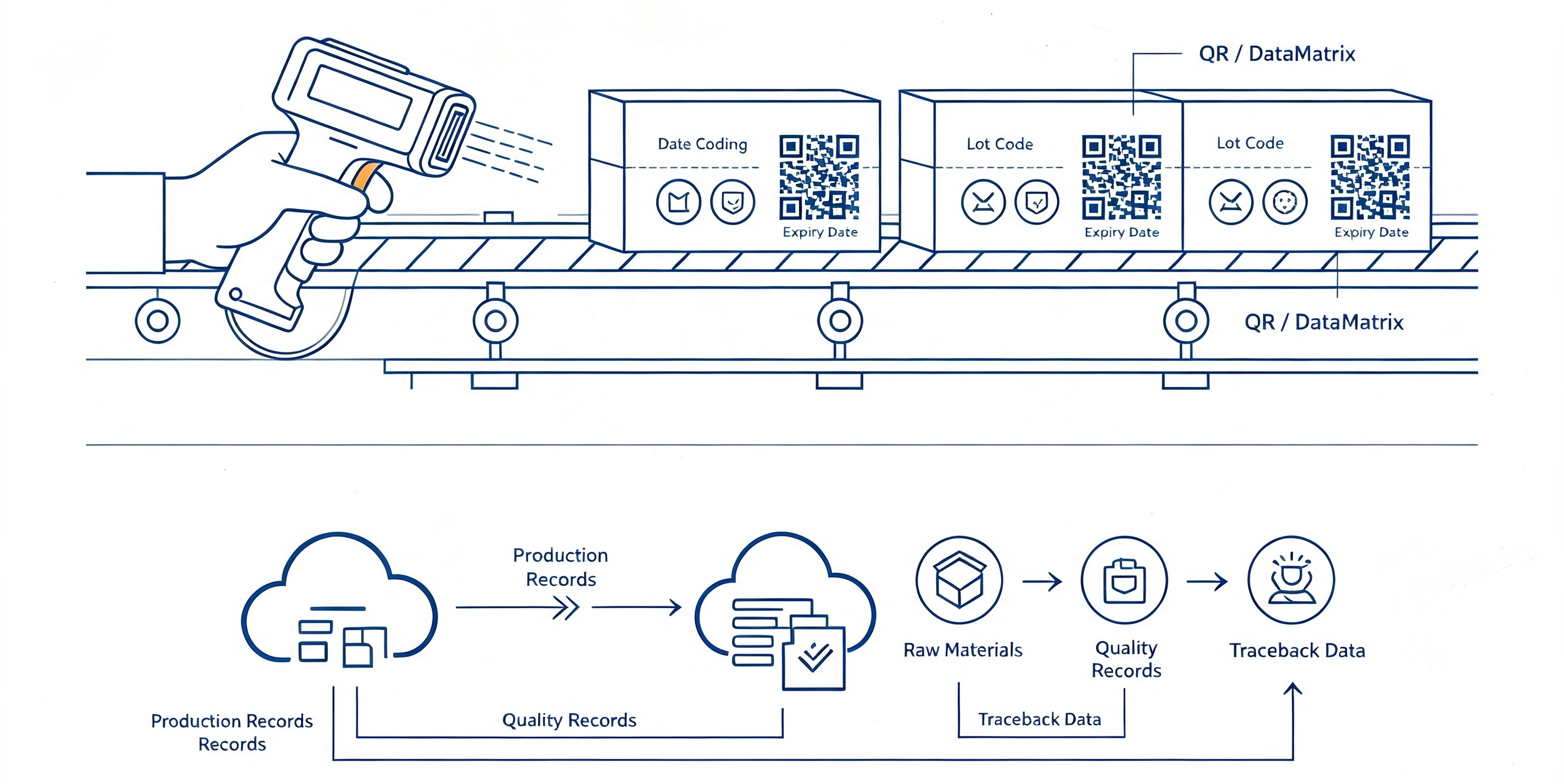
Handheld date coders help food manufacturers meet this requirement by printing batch numbers, production dates, and expiration dates directly onto packaging—creating scannable, machine-readable codes that link back to production records. QR codes and DataMatrix codes are increasingly used to encode this information, enabling quick traceback during recalls.
Key compliance needs:
- Clear, legible expiration dates that remain readable through cold chain and distribution
- Lot codes that tie each package to its production batch, raw materials, and quality records
- QR or DataMatrix codes that link to digital traceability data (FSMA 204 TLCs)
- Marks that survive moisture, abrasion, and temperature changes
2. Pharmaceuticals & Healthcare: Batch Traceability & Anti-Counterfeiting (EU MDR / UDI)
In pharmaceutical and medical device manufacturing, date coding is a regulatory requirement, not a best practice.
Key regulations:
- FDA UDI System: Medical devices must carry a Unique Device Identifier that includes production identifiers (lot/batch number, serial number, expiration date).
- 21 CFR Part 211: Drug manufacturers must assign a unique lot or control number to each batch of drug product, linking it to production records.
- EU MDR: Medical devices sold in the EU must meet similar traceability requirements, with UDI assigned at device level.
Handheld TIJ printers support these requirements by printing high-resolution DataMatrix codes that contain batch numbers, expiration dates, and serial numbers. The 600 DPI resolution ensures small codes remain scannable, and fast-dry solvent inks ensure marks remain legible through sterilization and long shelf life.
3. Industrial Manufacturing & Automotive: Direct Part Marking (DPM) & Serial Codes
Automotive and industrial manufacturers use handheld date coders for Direct Part Marking (DPM)—printing serial numbers, production dates, and QR codes directly onto metal, plastic, and rubber components. These marks survive oil, heat, and abrasion, enabling traceability throughout the product lifecycle.
Typical applications:
- Serial numbers on engine blocks and transmission housings
- Production dates on plastic molded parts
- QR codes on cable harnesses and connectors
- Batch codes on rubber seals and gaskets
4. Packaging & Logistics: Case Coding & QR Code Traceability
Handheld date coders print barcodes, QR codes, and shipping data directly on corrugated boxes, pallet labels, and shipping containers at the point of packing. No need to pre-print labels or walk to a central printing station.
Key benefits:
- Generate shipping barcodes and tracking data on demand
- Print pallet-level QR codes that encode entire shipment manifests
- Eliminate adhesive label costs and pre-printed packaging waste
- Support warehouse automation with scannable case codes
5. Construction Materials: Coding on Rough Porous Surfaces
Construction materials—lumber, pipes, concrete blocks, and steel beams—require durable marks that survive outdoor storage and handling. Water-based inks absorb into porous surfaces like wood and concrete, while solvent-based inks bond to non-porous surfaces like PVC pipes and coated steel.
Typical applications:
- Grade stamps and moisture content on lumber
- Production dates and quality certifications on concrete blocks
- Batch codes and specifications on PVC and metal pipes
- Safety warnings and handling instructions on steel beams
Substrate Compatibility: Solvent vs. Water-Based Inkjet Coding
Choosing the right ink for your substrate is the most important decision in date coding. The wrong ink will smear, fade, or fail to adhere.
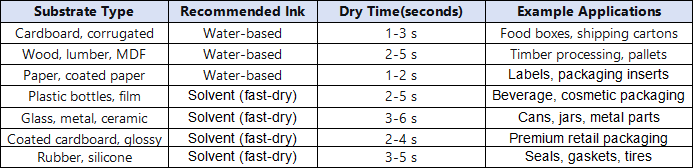
Rule of thumb: If the surface absorbs water (paper, wood, uncoated cardboard), use water-based ink. If it repels water (plastic, glass, metal, coated surfaces), use solvent-based ink.
Handheld Inkjet vs. Traditional Labeling and CIJ Printers
Handheld TIJ printers offer clear advantages over traditional labeling and continuous inkjet systems for date coding:

How to Choose the Right Handheld Inkjet Printer for Your Line
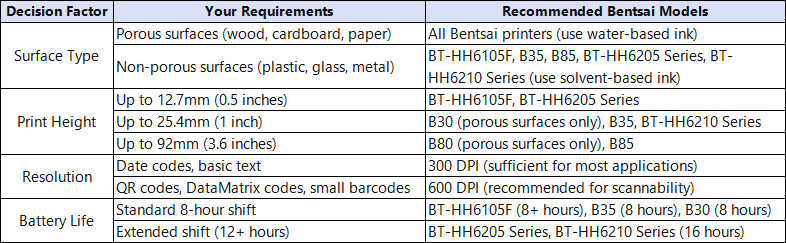
Selecting the right handheld date coder comes down to five factors: substrate, print height, resolution, shift length, and automation needs.
Notes:
- All models can be used manually. For automated production lines, choose a model that supports photoelectric sensor connection for conveyor belt integration.
- B30 and B80 printers are designed for porous surfaces only (use water-based ink). For non-porous surfaces, choose models that also support solvent-based ink.
For a full range of handheld inkjet printers, Bentsai offers solutions across print heights, resolutions, and substrate compatibilities.
Frequently Asked Questions
Q1: What is the difference between porous and non-porous ink cartridges?
Water-based ink cartridges are designed for porous surfaces like cardboard, wood, and paper. The ink absorbs into the surface, drying quickly without smudging. They are economical, low-odor, and food-safe for external packaging.
Solvent-based ink cartridges are made for non-porous surfaces like plastic, glass, metal, and coated packaging. The ink bonds to the surface and dries within seconds through evaporation. They resist moisture, abrasion, and temperature changes but have a stronger odor.
Q2: Can handheld inkjet printers print automatically updating date and time codes?
Yes. Bentsai handheld printers support variable data printing. You can set the date and time to update automatically each day or with each print job. The printer's built-in clock ensures the current date is always applied. This eliminates manual updates and reduces errors in expiration date coding.
Q3: How do handheld date coders assist with FDA FSMA 204 compliance?
Handheld date coders print the Traceability Lot Codes (TLCs) that FSMA 204 requires on food packaging. The printers can generate scannable QR codes or DataMatrix codes that encode lot numbers, batch IDs, and expiration dates in a machine-readable format. This enables the 24-hour traceback that the FDA requires for foods on the Food Traceability List. When a recall or contamination event occurs, these codes allow manufacturers to quickly identify which specific batches are affected—reducing waste and protecting consumers.
References:
About the Author

Matty Chen is an Inkjet Application Engineer, and BENTSAI Inkjet Printing technology Consultant. He specializes in industrial inkjet printing technologies, with a focus on handheld printers, thermal inkjet systems, and coding solutions. His work explores ink performance, material compatibility, and practical printing applications for businesses across manufacturing, packaging, and product customization industries.

The Ultimate Guide to Industrial Date Coding: Technology, Regulations, and Precision Equipment
How to Print Date Codes on Plastic: Industrial Solutions, Inks, and Regulations
Ask Question
No questions and answers

