The Ultimate Guide to Industrial Date Coding: Technology, Regulations, and Precision Equipment
What is Date Coding and Why is it Critical for Modern Supply Chains?
What is Date Coding?
Date coding is the process of marking date-related information — such as manufacturing date, expiration date, or best-before date — directly onto a product or its packaging. It helps businesses track freshness, manage inventory, and comply with safety regulations.
Why is industrial date coding mandatory?
Clear, accurate date codes protect public health by ensuring people don't consume expired or spoiled products. They also allow manufacturers to quickly isolate a specific batch during a recall, saving money and protecting brand reputation.
Supply chain losses due to improper or confusing date labels:
A report by the Food Ingredients First highlights that confusion and lack of standardization around packaging date labels account for over 4.3 million tons of wasted food annually. That's a massive financial and environmental problem — and a clear opportunity for manufacturers who adopt clear, consistent coding standards.
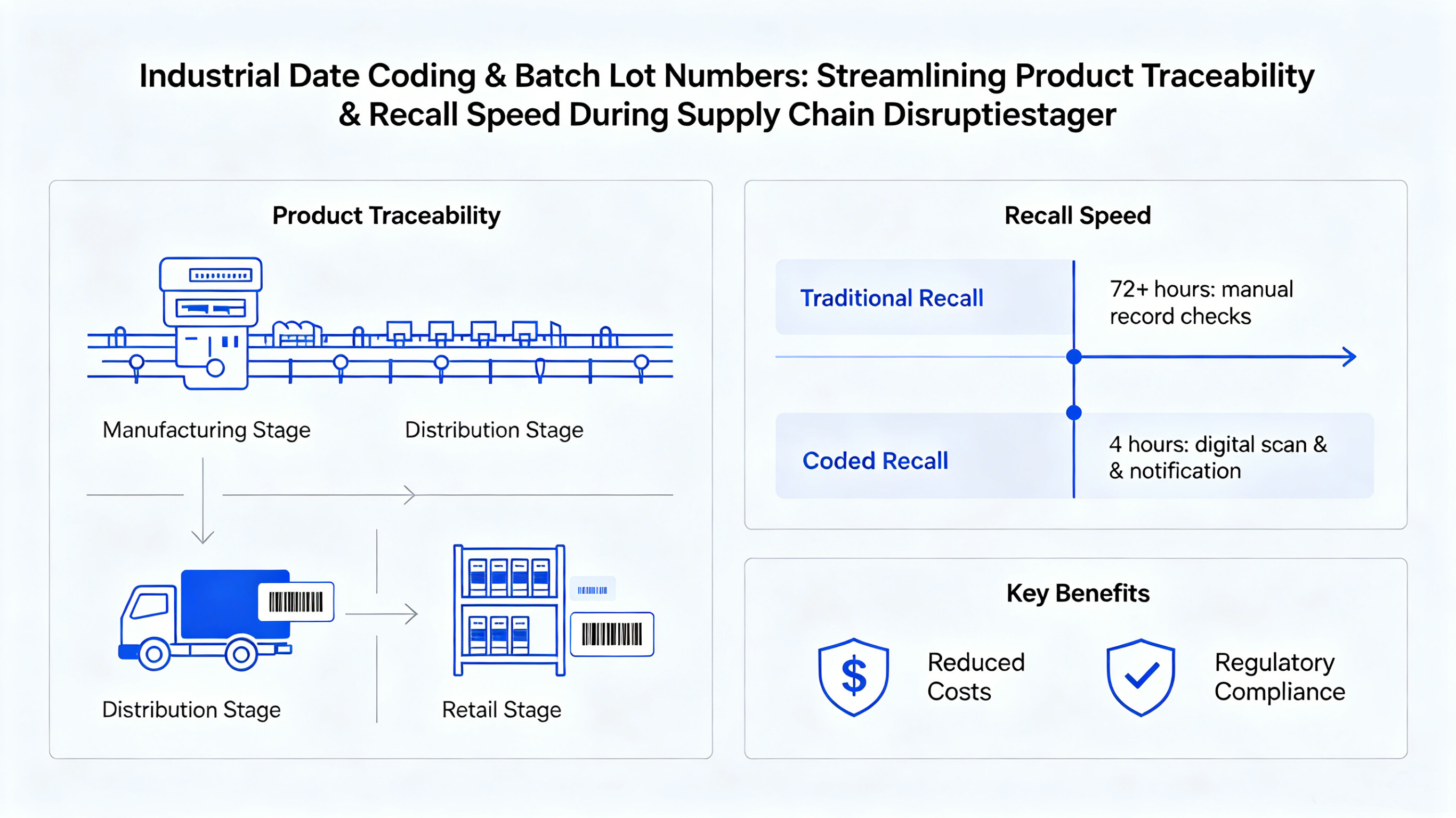
Primary Types of Manufacturing Date Codes
- Manufacturing Date (MFG)
The date when the product was made. Helps with inventory rotation, quality monitoring, and shelf-life tracking.
- Expiration Date (EXP)
The last date a product is considered safe or effective. Used for food, medicine, and cosmetics. Often labeled as "Use By" or "Best Before."
- Lot Number / Batch Code
A unique alphanumeric code assigned to one production run. Essential for traceability during recalls and quality investigations. For more details, check our guide on "Basic Knowledge about Batch Codes".
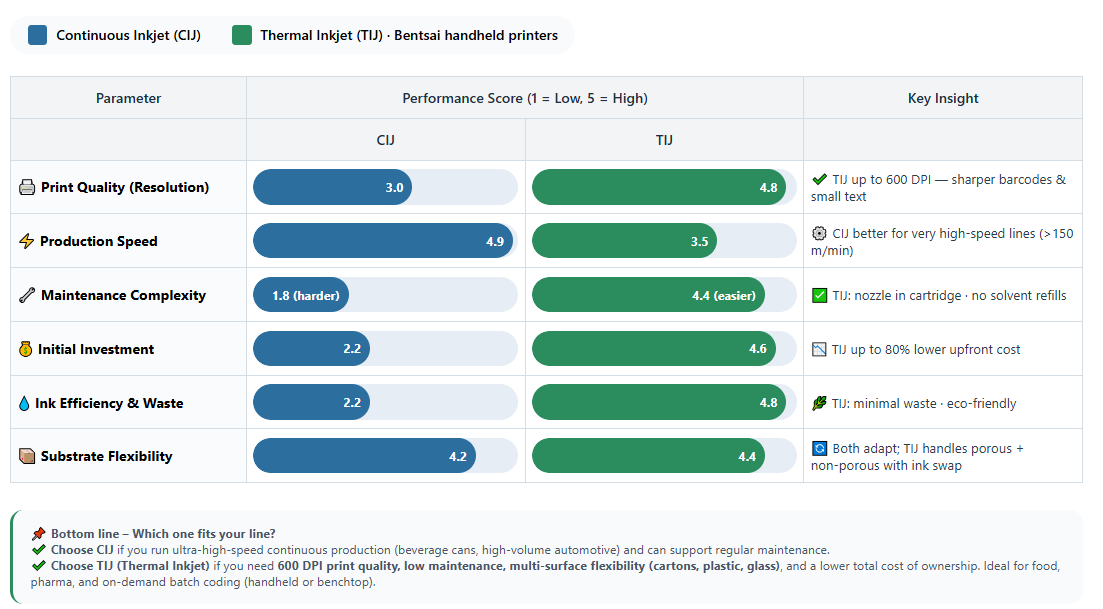
Comparative Analysis of Date Coding Printing Technologies
Continuous Inkjet (CIJ)
High-speed, non-contact printing. Works well on uneven surfaces. Common in high-volume food and beverage lines. However, it uses solvent-based inks and requires regular maintenance.
Thermal Inkjet (TIJ)
High resolution (up to 600 DPI), clean operation, and lower maintenance. Best for printing sharp barcodes, QR codes, and small text on cartons, labels, and porous surfaces. Bentsai handheld printers use TIJ technology.
Laser Marking
Permanent, tamper-proof marks. No ink or consumables. Very high upfront cost (often $20,000+). Best for metal, glass, or coated surfaces where durability is critical.
When evaluating operational costs and maintenance uptime, manufacturers must weigh these technologies carefully. For an in-depth technical breakdown, explore our complete comparison on "What's the difference between CIJ and TIJ printers?".
Cross-Industry Substrate Constraints and Practical Applications
What kind of ink is needed? The right ink depends entirely on your packaging surface. Pick the wrong one and your code will smear, rub off, or never dry.
Porous surfaces
Material types: Paper, cardboard, corrugated fiberboard, untreated wood, fabric.
Ink type: Water-based ink. It soaks into the surface, dries fast, and has low odor. Eco-friendly and inexpensive.
Non-porous surfaces
Material types: Plastic (PE, PET, PP), glass, metal, aluminum foil, coated paperboard, laminated films.
Ink type: Solvent-based or fast-dry ink. It adheres to slick surfaces without beading up. Dries in 2-5 seconds. More durable than water-based, but has a stronger smell.
Practical Application Examples
- Pharmaceuticals
Medicine boxes and bottles require extremely clear expiration dates and lot numbers. Regulators (like the FDA and EMA) demand high-contrast, smudge-proof codes that remain readable for the product's entire shelf life. TIJ printers at 600 DPI are a common choice.
- Food & Beverage
Dairy cups, meat trays, beverage cans, and snack pouches all need date codes. Surfaces vary widely — from absorbent cardboard to glossy plastic. A flexible printer that handles both water-based and solvent inks is ideal.
Printing legible tracking identifiers on synthetics requires specific chemical ink compounds and operational steps. Discover the exact procedures required in our resource on "How to Print Date Code on Plastic?"
Regulatory Compliance Mandates and Global Safety Guidelines
FSMA 204 (FDA): The U.S. Food Traceability Rule requires businesses that handle certain high-risk foods to maintain detailed records — including lot codes and traceability data — and share them with the FDA within 24 hours. Clear, scannable date codes are the first step to compliance.
European Union Traceability Regulations (European Commission / EFSA / EMA): EU rules (such as the General Food Law and FIC Regulation) require batch numbers and date marking for most packaged foods and pharmaceuticals. The goal is the same as FSMA 204: rapid traceability, consumer safety, and efficient recalls.
Conclusion: Optimizing Your Production Line with the Right Setup
Before you buy a date coding printer, run through this quick checklist:
- What surfaces do you print on? (porous, non-porous, or both?)
- What resolution do you need? (300 DPI for dates, 600 DPI for tiny barcodes)
- What's your daily volume? (low-mix/high-volume → automatic? high-mix/low-volume → handheld?)
- What's your total budget? (include ink, maintenance, and downtime)
- Do you need to meet FDA or EU traceability rules? (if yes, you need clear, scannable lot codes)
Ready to upgrade your production traceability? Browse our full lineup of Product Packaging Date Code Printers to find the perfect match for your substrate and line speed requirements.
About the Author

Matty Chen is an Inkjet Application Engineer, and BENTSAI Inkjet Printing technology Consultant. He specializes in industrial inkjet printing technologies, with a focus on handheld printers, thermal inkjet systems, and coding solutions. His work explores ink performance, material compatibility, and practical printing applications for businesses across manufacturing, packaging, and product customization industries.

Industrial Date Coding with Handheld Inkjet Printers: Industry Applications & Regulatory Guide
How to Print Date Codes on Plastic: Industrial Solutions, Inks, and Regulations
Ask Question
No questions and answers

