Porous vs. Non-Porous Ink Cartridges: Complete Handheld Printer Guide
If you've ever printed a date code on a plastic bottle and watched it smear off five seconds later, you've run into the porous vs. non-porous problem. Ink that works perfectly on a cardboard box will fail completely on a glossy label or a plastic container. The code smudges, flakes, or never dries.
The reason comes down to surface chemistry. Porous materials absorb ink like a sponge. Non-porous materials repel it. To get a durable mark on both, you need two different ink types—and a printer that supports them.
This guide explains the difference, shows you which materials need which ink, and helps you pick the right cartridge for your packaging.
For a full range of handheld inkjet printers that support both ink types, explore Bentsai's lineup.
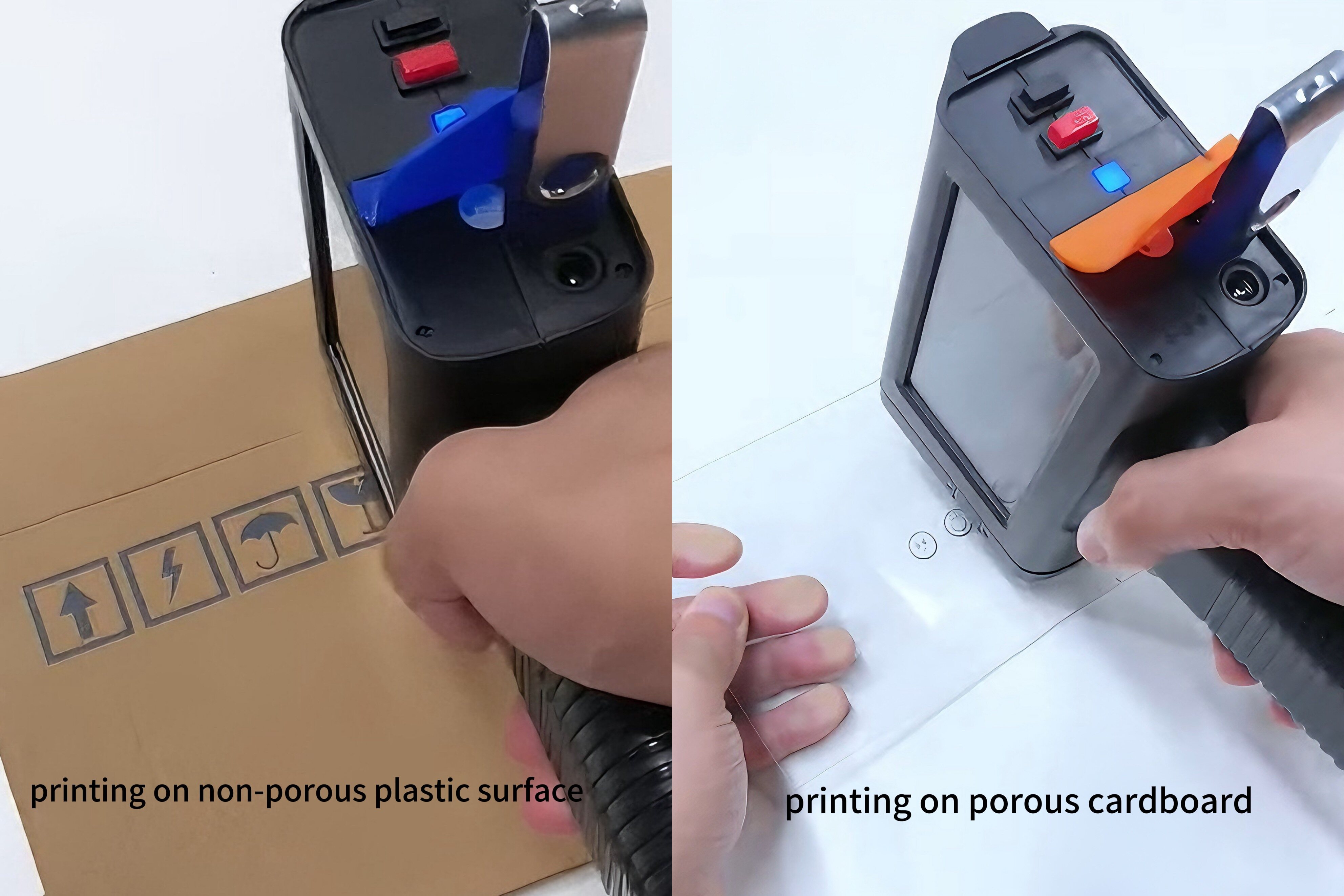
Understanding Porous Surfaces and Water-Based Inks
Porous and semi-porous substrates are materials with tiny openings that absorb liquid. When water-based ink hits the surface, it soaks into those openings and dries by absorption.
Common Materials
- Corrugated cardboard and paperboard
- Kraft paper and paper bags
- Raw wood and lumber
- Fabric and textiles
- Uncoated paper labels
- Fiberboard and particle board
Ink Characteristics
Water-based ink uses water as the carrier. It's economical, low-odor, and safe for food packaging. It soaks into porous materials and dries fast—usually 1 to 3 seconds.
Because it absorbs into the material rather than sitting on top, water-based ink produces a mark that won't rub off easily. But it won't work on plastic, glass, or metal—the ink just beads up and wipes away.
Understanding Non-Porous Surfaces and Solvent-Based Inks
Non-porous (impermeable) substrates are materials that don't absorb liquid. The surface repels water, so water-based ink can't bond to it.
Common Materials
- Plastic bottles, containers, and film
- Glass jars and bottles
- Metal cans, pipes, and plates
- Coated or glossy cardboard
- Laminated pouches
- Rubber and silicone
Ink Characteristics
Solvent-based ink uses a petroleum-based solvent as the carrier. It dries through evaporation—fast. Assisted drying can be under one second depending on the substrate, with typical dry times of 2 to 5 seconds.
The solvent slightly softens the plastic or metal surface, creating a chemical bond. The result is a waterproof, wear-resistant mark that resists smudging and moisture. Solvent inks have a stronger odor than water-based inks and require ventilation during printing.
Side-by-Side Comparison: Porous vs. Non-Porous Cartridges
| Factor | Water-Based Ink (Porous) | Solvent-Based Ink (Non-Porous) |
| Drying Time | 1–3 seconds (absorption) | 2–5 seconds (evaporation); under 1 second with assisted drying |
| Permanence | Deep penetration into fibers; won't rub off | Bonds to surface; waterproof and wear-resistant |
| Solvent Resistance | Not applicable (water-based) | Resists moisture, abrasion, and temperature changes |
| Best Surfaces | Cardboard, paper, wood, fabric | Plastic, glass, metal, coated packaging |
| Environmental Impact | Low odor, fewer toxins, food-safe | Stronger odor; requires ventilation |
| Cost | Lower cost per cartridge | Higher cost per cartridge |
How to Test Your Substrate Before Printing
Before you commit to a full production run, test your ink and material combination. Here's a simple method:
- Clean the surface: Wipe off dust, oil, or moisture. Ink won't stick to a dirty surface.
- Print a test code: Use the cartridge you plan to use in production.
- Wait for the stated dry time: 1–3 seconds for water-based, 2–5 seconds for solvent.
- Rub test: Press your thumb on the code and rub firmly. If it smears or lifts, the ink isn't bonding.
- Water test: Put a drop of water on the code. If it runs or fades, the ink isn't waterproof enough for your application.
- Scan test: If you're printing barcodes or QR codes, scan them immediately. If they don't scan on the first try, adjust resolution or ink type.
If the test fails, you're using the wrong ink for the surface. Switch to the correct type and test again.
In Conclusion
Matching the ink type to the substrate is the difference between a code that lasts and a code that smears off before the box leaves the warehouse. Porous materials need water-based ink. Non-porous materials need solvent-based ink. There's no single ink that works on both.
To find the right cartridge for your packaging:
- For porous surfaces (cardboard, paper, wood): explore porous ink cartridges
- For non-porous surfaces (plastic, glass, metal): explore non-porous cartridges
Always test before full production. It takes five minutes and saves hours of rework.
About the Author

Matty Chen is an Inkjet Application Engineer and BENTSAI Inkjet Printing Technology Consultant. He specializes in industrial inkjet printing technologies, with a focus on handheld printers, thermal inkjet systems, and coding solutions. His work explores ink performance, material compatibility, and practical printing applications for businesses across manufacturing, packaging, and product customization industries.
Ask Question
No questions and answers

