Complete Guide: Marking Porous and Rough Surfaces on Construction Sites
On a job site, a faded mark isn't just annoying—it causes mistakes. Lumber gets cut wrong. Blocks get laid in the wrong spot. Pipes get connected to the wrong line. All because someone couldn't read a marking that smudged, faded, or wore off.
Good marking keeps the job moving. It prevents rework and makes sure every worker knows what they're holding. Whether it's a grade stamp on timber, a batch code on concrete, or a cut length on steel, the mark has to survive weather, handling, and time.
This guide covers why the old tools fail on rough surfaces, what ink and printers actually work, and how to get marks that last.
Real Costs Resulting from Non-Permanent Markers
When marks fade, workers guess. And guessing means rework—the most expensive mistake on any job.
Rework costs the U.S. construction industry over $280 billion a year. A big chunk of that comes from misidentified materials and communication failures. When a lumber pack loses its grade stamp, or a concrete batch loses its cure date, or a pipe loses its spec label—you don't fix it with a quick touch-up. You tear it out and do it again.
You're not just paying for materials. You're paying for labor hours, project delays, equipment rental, and client penalties. A $2 marking tool that fails can trigger a $20,000 rework job.
Source: Cost of Rework in Construction
Know Your Surfaces: Porous vs. Non-Porous in Construction
Not all materials behave the same when ink hits them. The difference comes down to one thing: does the surface soak up liquid, or does it push it away?
Highly Porous & Rough
These materials soak up ink like a sponge. They have open pores, fibers, or rough texture that gives ink something to grab onto.
Examples:
- Raw lumber and timber
- Concrete blocks and poured concrete
- Brick and masonry
- Drywall and plasterboard
- Plywood and OSB
- Cardboard and paper packaging
Non-Porous
These materials push liquid away. Ink sits on top instead of soaking in, so it needs a different chemical approach to stick.
Examples:
- Metal beams and steel plates
- PVC and HDPE pipes
- Glass
- Ceramic tiles
- Plastic sheeting and wraps
- Treated or coated wood
Traditional Marking Tools vs. Handheld Printers
Job sites have used the same marking tools for decades. But those tools weren't built for today's traceability rules, barcode scanning, or weather resistance.
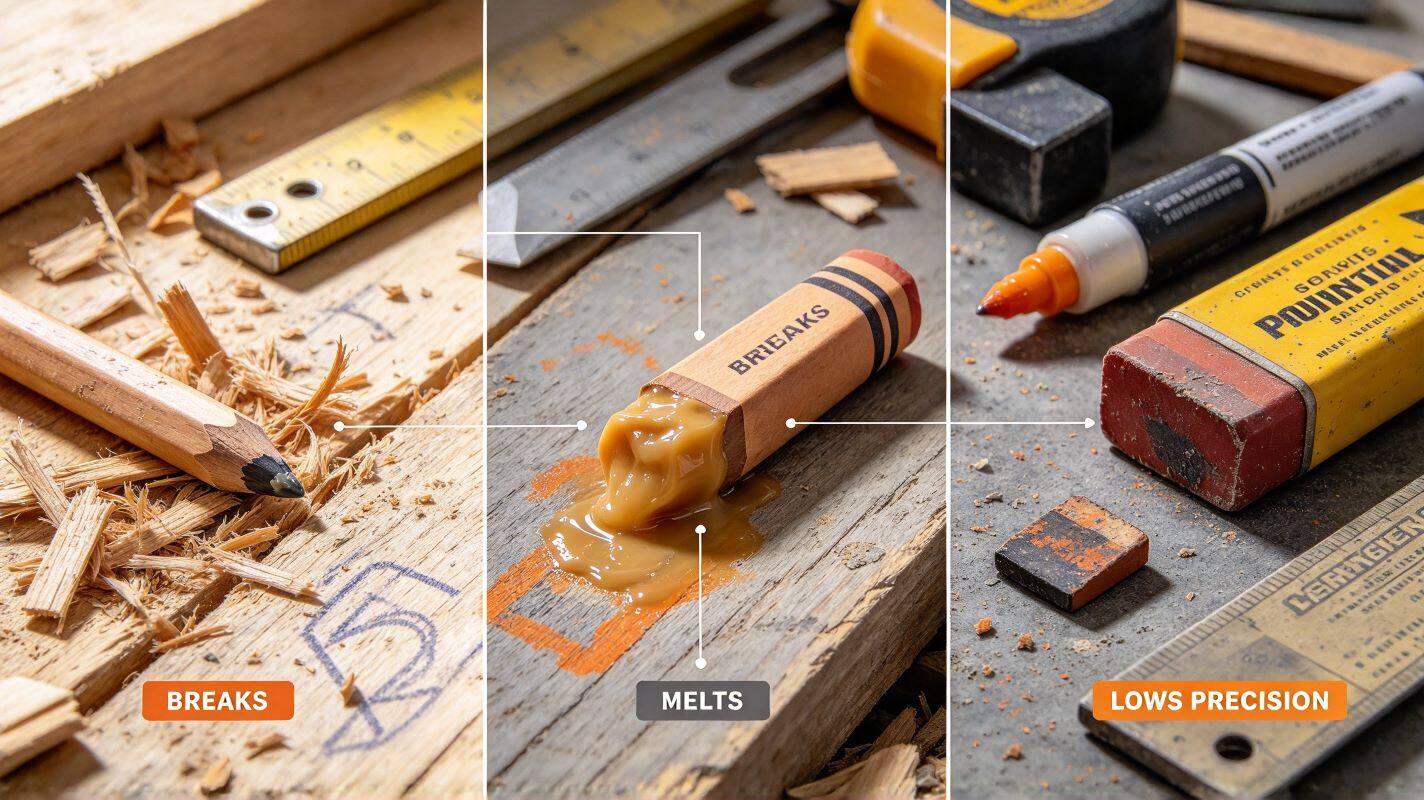
Problem: Disadvantages of traditional tools
- Woodworking pencils: Snap on rough lumber. Fade in the sun. Can't print barcodes.
- Wooden crayons: Melt in heat. Smear on wet surfaces. Thick, messy marks.
- Paint markers: Slow to dry. Clog. Need shaking and priming. Can't change data.
- Stamps and stencils: Slow. Messy. Can't change info without a new stencil. Useless for serial numbers.
- Spray paint: Overspray. No precision. Can't make scannable codes.
None of these tools can print a QR code. None can print a changing serial number. None can survive the full life of a construction material.
Solution: The Modern Solution (handheld inkjet printers)
Handheld inkjet printers fix every problem the old tools create. They print sharp text, barcodes, QR codes, and logos directly onto rough or smooth surfaces. They use fast-dry inks that stick to the material. They're portable, battery-powered, and ready in seconds.
Why they work better:
- Print changing data—batch numbers, dates, serial codes
- Work on porous and non-porous surfaces with the right ink
- Make scannable barcodes and QR codes for tracking
- Marks that survive weather, handling, and storage
- No stencils, no setup, no mess
Choosing the Right Ink for Construction Materials
The ink you pick decides whether your mark lasts a week or a year. For construction, two types cover almost everything:
- Water-Based Inks
Best for: Porous and absorbent surfaces—raw lumber, concrete, cardboard, drywall, plywood, OSB.
Water-based ink soaks into the material and dries by absorption. It leaves a deep mark that won't rub off easily. It's also low-odor and safe to use indoors.
Limitations: Won't stick to plastic, metal, or glass. Can fade outdoors over time with heavy rain or sun.
- Solvent-Based Inks
Best for: Non-porous surfaces—metal, PVC, HDPE, glass, treated wood, coated materials.
Solvent-based ink bonds to the surface and dries in seconds. It resists moisture, rubbing, and temperature changes. It's the right choice for pipes, steel beams, and anything stored outside.
Limitations: Stronger smell. Needs ventilation while printing. Usually not refillable.
Step-by-Step Guide: Best Practices for Marking Rough Surfaces
Marking a rough, uneven surface takes a bit more care than printing on a smooth box. Follow these steps for the best results:
- Clean the surface: Brush off dust, dirt, or loose material. Ink won't stick to a dirty surface.
- Pick the right ink: Water-based for wood and concrete. Solvent-based for metal and plastic.
- Set the print distance: Keep the printhead 2–5mm from the surface. Too close smears; too far spreads the dots.
- Use the positioning plate: For uneven or curved surfaces, attach the positioning plate (included with Bentsai printers) to keep the printhead at a steady distance.
- Move at a steady speed: Handheld printers adjust to your speed, but steady movement gives the cleanest marks.
- Test on a scrap piece first: Before marking the real thing, test on a similar material to check adhesion and readability.
- Let it dry: Water-based ink dries in 1–3 seconds on porous surfaces. Solvent ink dries in 2–5 seconds on non-porous surfaces. Don't touch the marked area right after printing.
Recommended Marking Solutions
Bentsai offers three handheld inkjet printers for construction site marking. Each is built for different surfaces and print sizes.
For structural timber, drywall, and other highly absorbent materials, water-based ink gives you the deepest penetration. Devices like the B30 and B80 wide-format handheld printers are built specifically to use water-based inks. They print on wood, cardboard, concrete, and other porous surfaces. And their refillable cartridges cut ink costs by up to 70%.
Bentsai B30
- Print height: up to 25.4mm (1 inch)
- 300 DPI resolution
- Water-based ink only (porous surfaces)
- Refillable cartridges
- 8 hours battery life
- Best for: Lumber, drywall, cardboard, wood crates
Bentsai B80
- Print height: up to 92mm (3.6 inches)
- 300 DPI resolution
- Water-based ink only (porous surfaces)
- Refillable cartridges
- 8GB memory
- Best for: Large-format marking on timber, concrete blocks, cement walls
But what if your job site has more than just wood and concrete? That's where the B85 comes in. Unlike the B30 and B80, the B85 is built for mixed materials—the kind you find on almost every construction site. It handles both water-based ink for porous surfaces and solvent-based ink for non-porous surfaces. That means you can mark lumber in the morning and switch to metal beams, PVC pipes, or plastic sheeting in the afternoon without changing printers. The B85 is the only model in this lineup that prints on non-absorbent materials like metal, glass, and plastic—making it the most versatile choice for general construction work.
Bentsai B85 (for mixed surfaces)
- Print height: up to 92mm (3.6 inches)
- 300 DPI resolution
- Supports both water-based and solvent inks
- Prints on porous and non-porous surfaces
- Best for: Job sites with mixed materials—wood, metal, plastic, glass
Frequently Asked Questions
Q1: Can you print barcodes on raw construction wood?
A: Yes. Handheld TIJ printers can print scannable barcodes and QR codes right on raw lumber. Water-based ink soaks into the wood, leaving a mark that won't rub off during handling. For best results, use a printer with at least 300 DPI and test on a scrap piece first.
Q2: How long does solvent ink take to dry on concrete?
A: Solvent ink isn't usually used on concrete—concrete is porous, so water-based ink is the better choice. Water-based ink dries in 1–3 seconds on concrete by soaking in. If you're printing on sealed or coated concrete (non-porous), solvent ink dries in 2–5 seconds.
Q3: Will rain wash away water-based ink on lumber?
A: Water-based ink soaks into the wood, so light rain won't wash it off right away. But heavy rain and sun over time can cause fading. For lumber stored outside for long periods, consider solvent-based ink or a printer that handles both ink types. Always test under real conditions before full production.
In Conclusion
Durable marking on construction sites isn't optional—it's how you prevent rework, keep workers safe, and stay on schedule. Old tools like pencils and crayons can't handle rough surfaces, changing data, or scannable codes. Handheld inkjet printers with the right ink solve all three problems. Use water-based ink for wood and concrete. Use solvent-based ink for metal and plastic. And always test your ink and material combo before full production.
About the Author

Matty Chen is an Inkjet Application Engineer, and BENTSAI Inkjet Printing technology Consultant. He specializes in industrial inkjet printing technologies, with a focus on handheld printers, thermal inkjet systems, and coding solutions. His work explores ink performance, material compatibility, and practical printing applications for businesses across manufacturing, packaging, and product customization industries.
Ask Question
No questions and answers

