Drop-On-Demand (DOD) vs. Standard TIJ: Throw Distance & Readability Explained
Drop-On-Demand (DOD) and Thermal Inkjet (TIJ) are the two main inkjet technologies used in industrial coding. The difference comes down to a simple trade-off: DOD prints from farther away with bigger characters. TIJ prints closer to the surface with sharper detail.
DOD printheads (especially piezoelectric ones) shoot larger ink drops with more force. That force keeps the drops on target even when the printhead is up to 30mm away from the surface. TIJ printheads fire much smaller drops and need to stay close—usually 2 to 5mm—to keep 600 DPI print quality. At that close range, TIJ gives you sharper barcodes, smaller text, and finer graphics.
Neither technology is "better." The right choice depends on what you're printing on, how your line is set up, and what the code needs to do.
DOD vs. TIJ
| Feature | Standard TIJ | Drop-On-Demand (DOD) |
| Throw Distance | 2–5mm (up to 7mm in advanced systems) | Up to 30mm (piezoelectric) |
| Max Resolution | Up to 600 DPI | Lower resolution; larger droplets |
| Print Height | 12.7mm to 92mm (Bentsai models) | Larger character capability |
| Best Substrates | Smooth or slightly uneven surfaces | Rough, uneven, or hard-to-reach surfaces |
| Best Use Case | High-resolution barcodes, QR codes, small text | Large-character marking on rough surfaces, curved pipes |
The Mechanics of "Throw Distance" and Long-Distance Readability
1. Why Standard TIJ requires a tight 1/4" (6.4 mm) throw distance to prevent ink droplet distortion and maintain 600 DPI crispness
TIJ printheads fire very small drops. We're talking about 6 to 10 picoliters each. These drops are tiny and light.
If the printhead is too far from the surface, air slows the drops down. They start to spread before they land. What happens next? Blurry text. Distorted barcodes. Codes that won't scan.
That's why Bentsai TIJ printers work best with a 2 to 5mm gap between the nozzle and the surface. Inside that range, drops land exactly where they're aimed. Outside it, quality drops fast.
2. How DOD (especially Piezo-based DOD) shoots larger droplets with greater kinetic energy, maintaining structural integrity over wider gaps (up to 30mm)
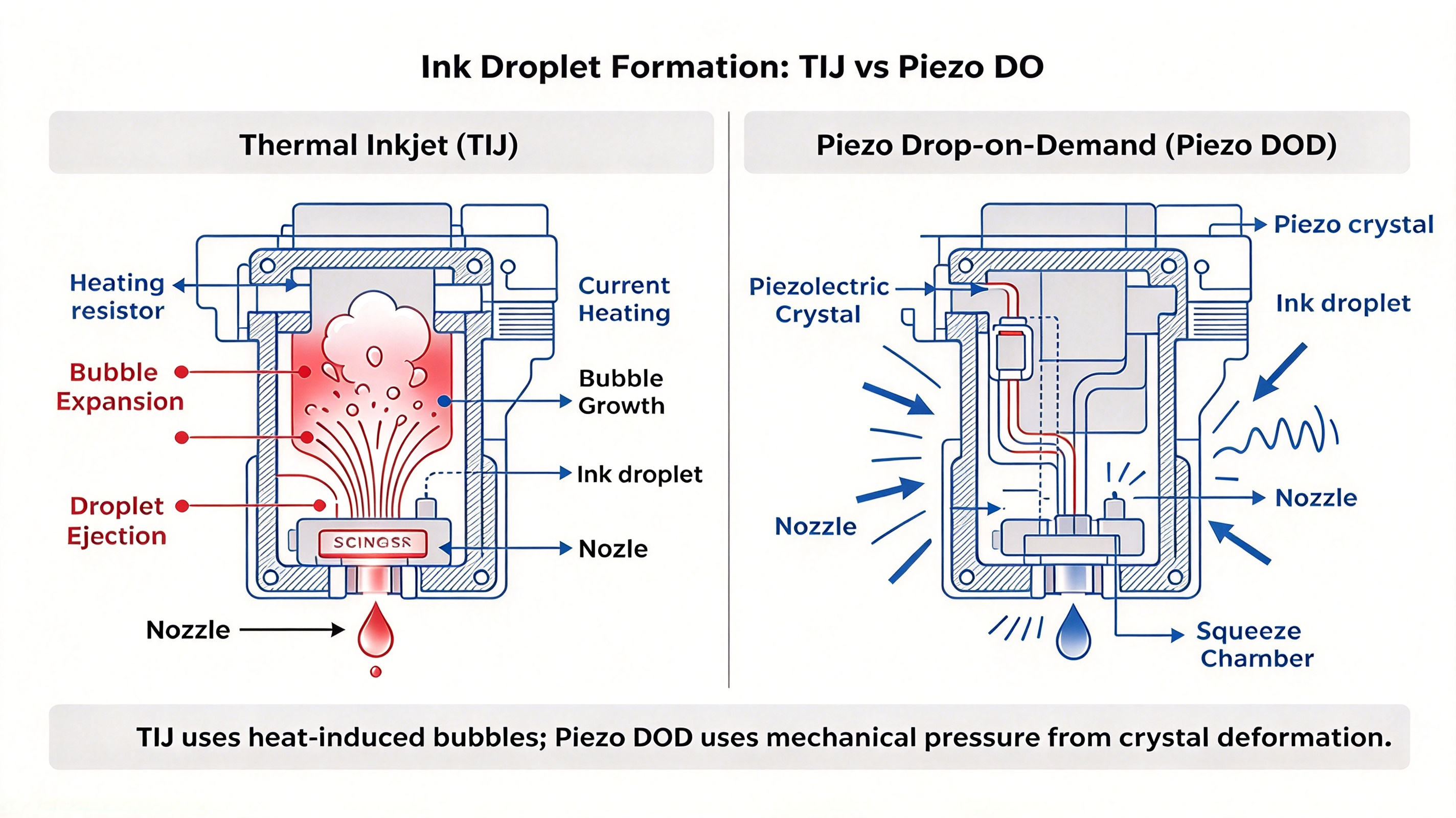
Piezoelectric DOD printheads work in a different way. Inside the printhead is a tiny crystal. When voltage is applied, the crystal changes shape. That movement pushes ink through the nozzle. It's a mechanical push, not a heat-based one.
This push creates bigger, heavier drops. Those drops have more momentum than thermal ejection. Bigger drops resist air drag better. They stay on course across wider gaps.
The trade-off? DOD can't match TIJ's fine detail. A TIJ drop makes sharp 600 DPI text. A DOD drop makes bigger, bolder marks. They're readable from farther away—but not as crisp up close.
Substrate texture: a key factor affecting readability
● Uneven/Porous Surfaces
Think about corrugated cardboard, raw lumber, or concrete. These surfaces aren't flat. They have bumps, dips, and rough spots.
A TIJ printhead stays 2–5mm away from the surface. On a flat box, that's fine. On corrugated material, the printhead might hit a raised flute. Or it might drift too far from a recessed area.
DOD systems handle this better. Their wider throw distance means the printhead can stay farther back. It doesn't need to hug the surface. So bumps and dips don't matter as much.
● Smooth/Non-Porous Surfaces
Now think about plastic bottles, glass containers, metal cans, and glossy labels. These surfaces are clean and flat.
This is where TIJ shines. The printhead has a consistent plane to work against. TIJ's close throw distance isn't a problem here—it's a plus. You get the sharpest barcodes and the smallest readable text.
So here's the rule:
- Smooth surfaces → TIJ is better
- Rough or uneven surfaces → DOD has the edge
Choosing the Right Printer for Your Production Line
● When to choose 0.5-inch to 1-inch TIJ systems
Choose a 0.5-inch TIJ printer or 1-inch TIJ printer when:
- You need high-resolution barcodes and QR codes that scan on the first attempt
- Your substrates are smooth or consistent—cartons, bottles, cans, labels
- Your print height requirement is 12.7mm or less (0.5-inch) or up to 25.4mm (1-inch)
- You're printing small text, lot codes, or date codes
The BT-HH6105F delivers 600 DPI for the sharpest barcodes. The B35 offers 300 DPI at 1-inch height for larger logos and QR codes.
● When to upgrade to Large Character (DOD-style or stitched-head) solutions
Consider DOD or wide-format systems when:
- Your surfaces are rough, uneven, or curved—pipes, lumber, concrete, textured plastic
- You need large characters for distance readability—safety warnings, pallet codes
- The printhead must stay farther from the surface due to obstacles or movement
- You're marking non-flat industrial parts where a close throw distance isn't practical
Bentsai's B80 and B85 wide-format handheld printers bridge this gap. They use stitched printhead technology to achieve large print heights (up to 92mm) while still using TIJ droplet mechanics. They're not true DOD, but they offer the large-character capability of DOD with the portability of handheld TIJ.
Conclusion
DOD and TIJ solve different problems. DOD shoots larger droplets across wider gaps—ideal for rough surfaces and large characters. TIJ fires smaller droplets at close range—ideal for high-resolution barcodes and precise text. Match the technology to your substrate and your readability requirements, and you'll get clean, scannable codes every time.
Frequently Asked Questions
Q: What is the maximum throw distance for a TIJ printer?
A: Most TIJ systems specify 2–5mm. Advanced TIJ 4.0 systems can reach up to 7mm while maintaining acceptable quality. Beyond that, droplet distortion degrades readability.
Q: Why do barcodes distort when printed from a distance?
A: Small TIJ droplets lose velocity and spread as they travel. At longer throw distances, the precise dot placement needed for barcode scanning breaks down. The code may look "fuzzy" or "bleeding" to a scanner, causing failed reads.
Q: Can TIJ print on corrugated boxes?
A: Yes. Corrugated is a common TIJ substrate. The key is keeping the printhead at the correct distance and using the right ink (water-based for cardboard). Handheld TIJ printers with positioning plates help maintain consistent distance on slightly uneven corrugated surfaces.
About the Author

Matty Chen is an Inkjet Application Engineer, and BENTSAI Inkjet Printing technology Consultant. He specializes in industrial inkjet printing technologies, with a focus on handheld printers, thermal inkjet systems, and coding solutions. His work explores ink performance, material compatibility, and practical printing applications for businesses across manufacturing, packaging, and product customization industries.
Ask Question
No questions and answers

