Cosmetics & Skincare Coding Guide: Microprinting Batch Codes on Curved Glass Dropper Bottles and HDPE Tubes
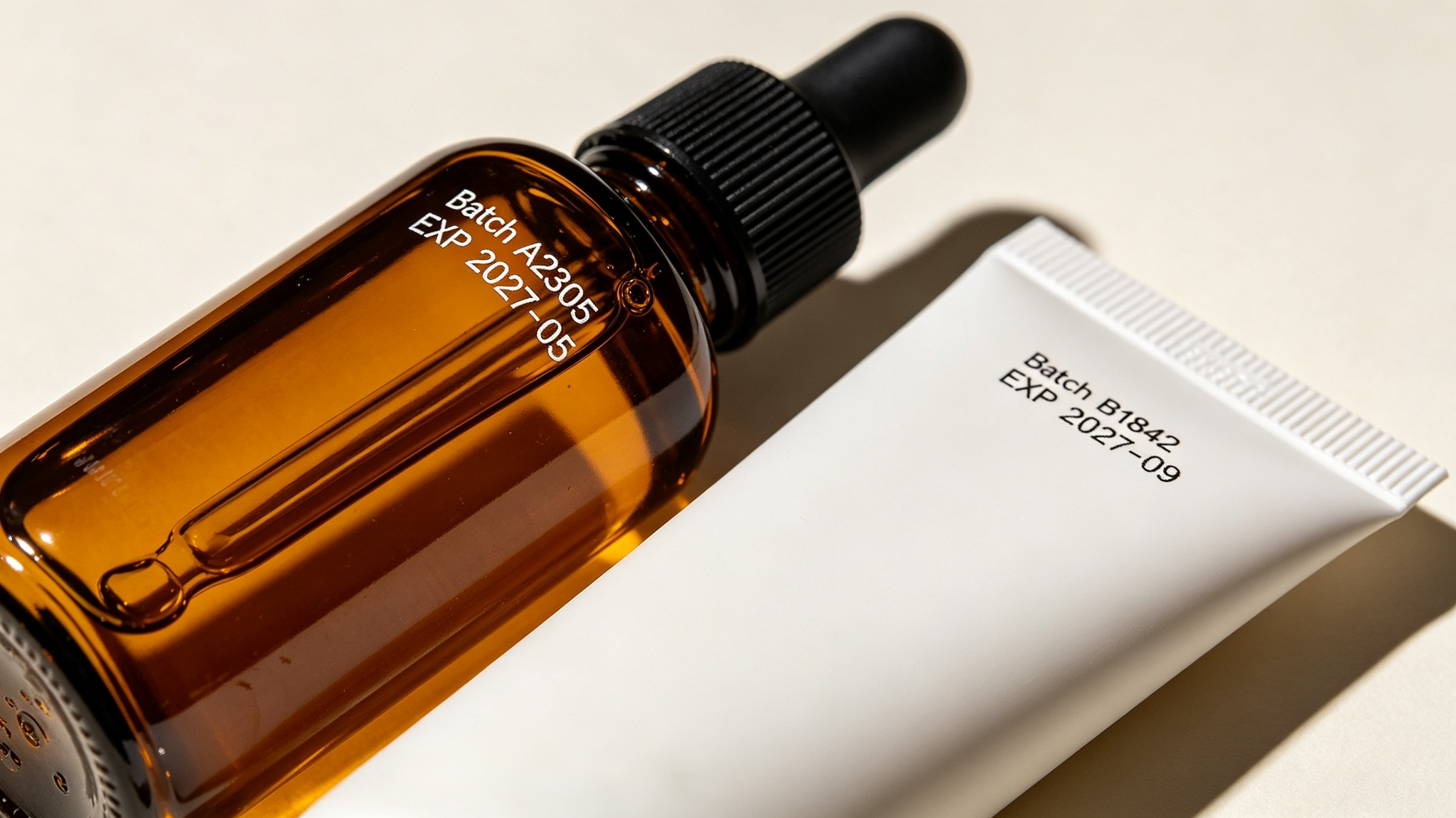
Cosmetic packaging is getting smaller, sleeker, and harder to label. A 15ml dropper bottle has no room for a sticker. An HDPE squeeze tube repels ink like water off wax. That's why more skincare brands are moving away from adhesive batch labels and printing the code directly on the container.
Direct-to-container micro-printing solves two problems at once: it eliminates label waste and it puts the batch code exactly where regulators and consumers expect to find it. For small-batch bottling operations, cosmetic packaging printing machines that use thermal inkjet (TIJ) technology offer a practical way to do this without a full production line overhaul.
Why Batch Coding Matters in Skincare and Custom Bottling?
Under EU Regulation 1223/2009, cosmetic products can only be sold if the container or packaging carries a batch number in indelible, easily legible, and visible lettering. If the product is too small for practical reasons, the batch number can appear on the outer packaging only—but for brands doing custom bottling, printing directly on the bottle or tube is often the only viable option.
In the U.S., the Modernization of Cosmetics Regulation Act of 2022 (MoCRA) also requires batch numbers on cosmetic labels for traceability in case of recalls or adverse events. MoCRA doesn't prescribe a fixed batch format—what matters is that the code is unique, readable, and links back to your production records.
A legible batch code is the foundation of recall management. If a formula issue arises, the batch number tells you exactly which production run to pull—not every unit you've ever shipped.
The Substrate Challenges of Micro-Printing on Curved Glass vs. HDPE Tubes
Overcoming Tight Curvature & Condensation on Glass Dropper Bottles
Glass is non-porous. Ink doesn't soak in—it has to bond to the surface. On a curved dropper bottle, the printhead must follow the curve at a consistent distance to avoid distortion. Condensation from cold-fill or refrigerated storage makes it worse: Bentsai inks cannot print on a wet surface. The glass must be dry at the point of printing.
Solvent-based TIJ inks are designed for this. They bond to dry glass and dry in seconds. But the surface must be clean and moisture-free before the printhead fires.
Solving Low Surface Energy on HDPE Squeeze Tubes
HDPE has low surface energy—it actively repels liquids. Standard inks bead up and wipe off. Solvent-based inks are formulated to slightly soften the plastic surface and create a bond. Even so, the surface must be free of oil, mold release agents, or dust. If the tube is oily, the ink will diffuse and fail to adhere entirely.
How to Micro-Print Crisp 0.8mm–2.5mm Batch Codes (Step-by-Step Workflow)
- Clean the surface: Wipe the glass or HDPE with a lint-free cloth. For HDPE, use isopropyl alcohol to remove any mold release residue. Let it dry completely.
- Select the right ink: Solvent-based fast-dry ink for both glass and HDPE. Water-based ink will not work.
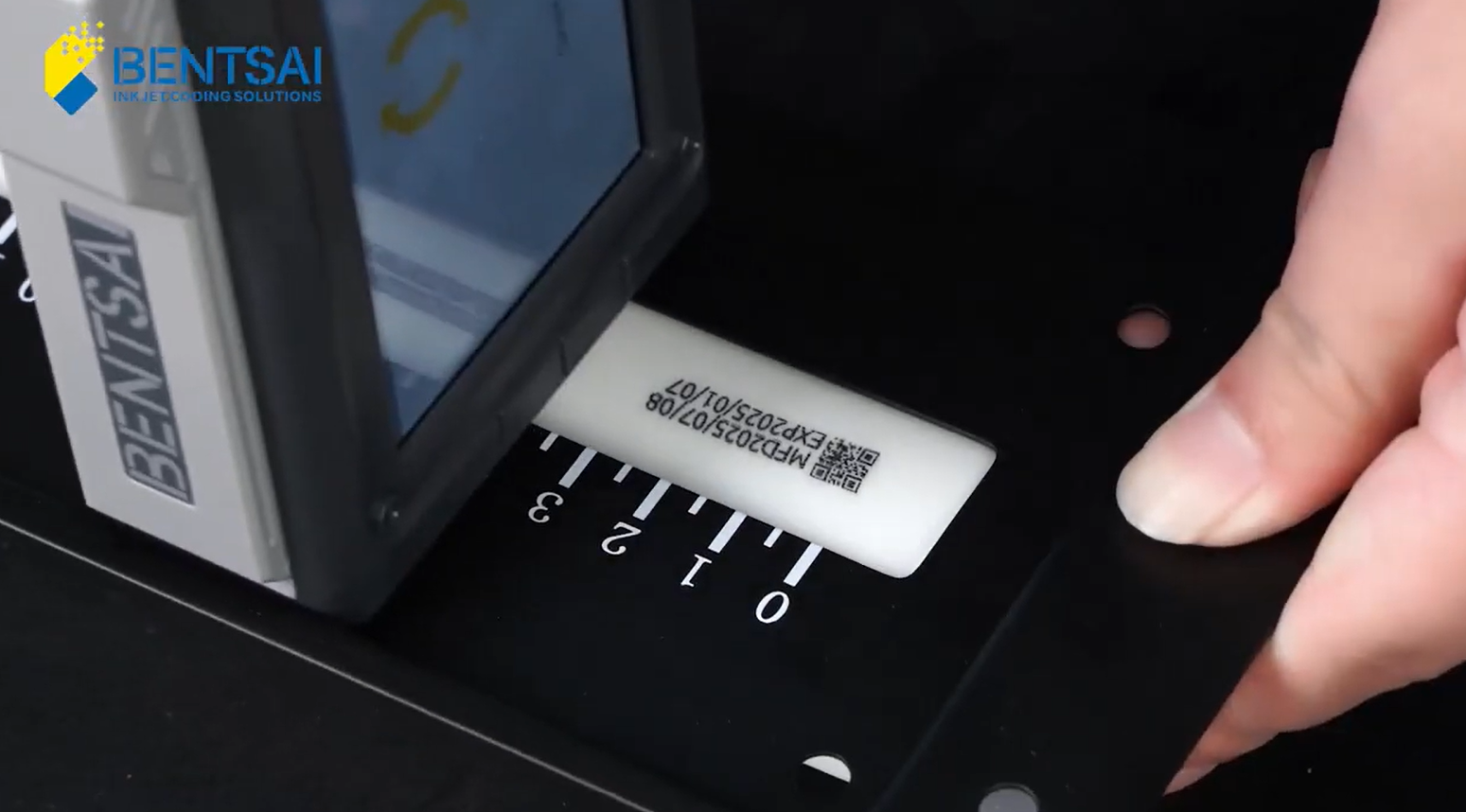
- Set the print height: For micro-printing on small bottles, use a printer that supports character heights down to 0.8mm. The Bentsai BT-HH6210 series offers adjustable print height from 0.8mm to 25.4mm.
- Position the printhead: Keep the throw distance at 2–5mm. On curved surfaces, use the positioning plate to maintain a consistent gap as you follow the curve.
- Print and let cure: Solvent ink dries in 2–5 seconds. Don't touch the code until it's fully dry.
- Verify legibility: Check that the batch number is readable and matches your production records.
Handheld TIJ Printers vs. Industrial CIJ and Laser Coders for Custom Bottling
| Factor | Handheld TIJ (Bentsai) | Industrial CIJ | Laser Coder |
| Cost | $530–$2,199 upfront | $10,000+ upfront | $20,000+ upfront |
| Minimum Character Size | 0.8mm (BT-HH6210 series) | ~1mm | ~0.5mm |
| Maintenance | Replace cartridge only | Frequent service, solvents | Minimal, but high repair cost |
| Curved Surface Handling | Manual follow-the-curve or positioning plate | Non-contact, handles curves well | Non-contact, handles curves well |
| Best Production Scale | Small to medium batch, multi-line, custom bottling | High-volume continuous lines | High-volume, permanent marks |
For small-batch cosmetic bottling, handheld TIJ offers the lowest entry cost and the flexibility to switch between products without setup downtime. handheld TIJ printers with solvent ink cartridges are the practical choice for brands that need professional batch codes without a fixed line investment.
FAQs
Q1: What is the smallest readable batch code size for 15ml–30ml dropper bottles?
With a Bentsai BT-HH6210 series printer, you can print character heights down to 0.8mm. At that size, the code is legible but requires a steady hand and a clean, dry surface. For most 15ml–30ml bottles, a 1.5mm–2.5mm character height offers a better balance of readability and print reliability.
Q2: How do you remove a misprinted solvent batch code from glass or HDPE?
Solvent-based TIJ ink is designed to bond—it's not meant to wipe off easily. For glass, isopropyl alcohol (IPA) can soften and remove the ink. For HDPE, IPA may work but test on a scrap piece first to ensure it doesn't haze the plastic. Do not use water-based cleaners—they won't break down the solvent ink. Always test any removal method on a sample before applying to production units.
Q3: Can a handheld printer mount to a small cosmetic filling conveyor?
Yes. Bentsai handheld printers like the BT-HH6210BL feature a photoelectric sensor printing mode. The printer can be mounted on a bracket above a small conveyor, and the sensor triggers each print as a bottle or tube passes. This gives you automated coding without the cost of a full industrial CIJ system. For very small operations, handheld operation is simpler and requires no mounting hardware.
About the Author

Matty Chen is an Inkjet Application Engineer and BENTSAI Inkjet Printing Technology Consultant. He specializes in industrial inkjet printing technologies, with a focus on handheld printers, thermal inkjet systems, and coding solutions. His work explores ink performance, material compatibility, and practical printing applications for businesses across manufacturing, packaging, and product customization industries.
Ask Question
No questions and answers

