Handheld Printers for Batch and Date Coding: Complete Guide & Best Models
Batch codes and date codes are the unsung heroes of product traceability. They link every item back to its production run, making recalls targeted, quality control efficient, and regulations manageable.
Handheld batch code printers bring this capability directly to your production line—no fixed installation, no conveyor integration required. Whether you're marking bottles, boxes, or bags, these portable devices print expiration dates, lot numbers, and batch codes wherever the product sits.
This guide covers what batch and date code printers do, why codes matter, and which Bentsai model fits your needs.
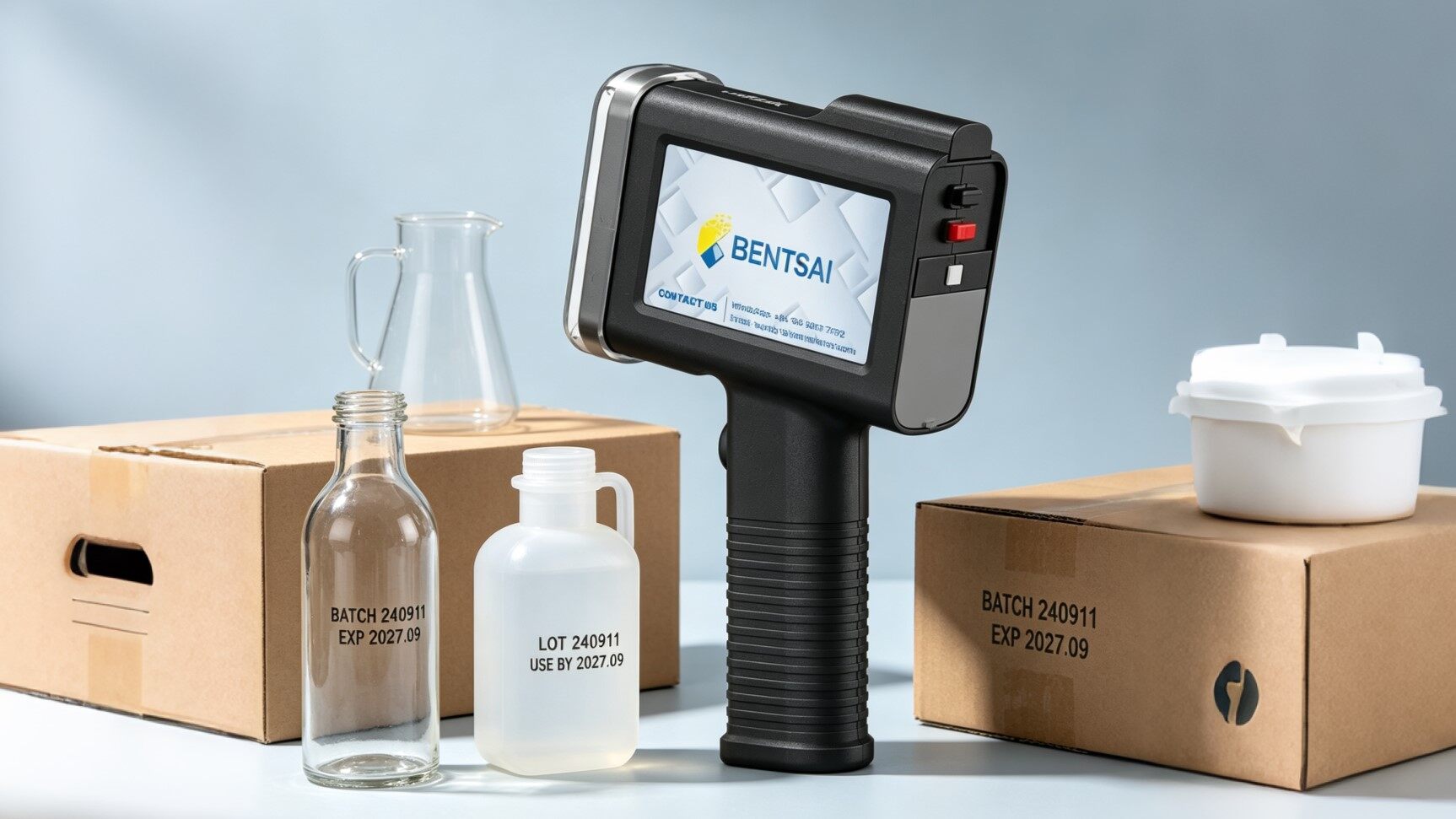
What is a Handheld Date and Batch Code Printer?
A handheld date and batch code printer is a portable, battery-powered device that prints expiration dates, manufacturing dates, batch numbers, lot codes, barcodes, and QR codes directly onto products or packaging.
The Critical Role of Date and Batch Codes in Product Traceability
Batch and date codes do more than just look like random numbers—they're the backbone of product safety and quality control.
Regulatory Compliance
Regulators require traceability. The FDA's FSMA 204 requires businesses handling foods on the Food Traceability List to maintain Traceability Lot Codes and share records within 24 hours. GS1 Sunrise 2027 pushes retailers to accept 2D barcodes (QR codes and DataMatrix) at point of sale. Batch and date codes on packaging are the first step toward meeting these mandates.
Without proper codes, you risk fines, forced recalls, and lost consumer trust.
Targeted Recalls & Consumer Safety
When something goes wrong—contamination, mislabeling, or a defective batch—a lot code tells you exactly which products are affected. Instead of recalling every unit you've ever made, you pull only the problematic batch. This saves millions in recall costs and protects your brand reputation.
For consumers, traceable products mean safer food, effective medicine, and reliable goods.
Application Examples by Industry
- Food Packaging: Print expiration dates, best-by dates, and batch codes on dairy cups, meat trays, frozen food boxes, and pouches. Handheld printers let you code products anywhere, reducing label waste.
- Pharmaceuticals: Apply lot numbers and expiration dates on medicine boxes, blister packs, and bottles. High-resolution codes meet FDA 21 CFR Part 211 and UDI requirements.
- Logistics: Generate barcodes and QR codes on shipping boxes at the point of packing. No walking to a central label station—print on the spot.
How to Choose the Right Bentsai Batch Code Printer
Bentsai offers three handheld models for batch and date coding. Each is designed for different print heights, surfaces, and production volumes. Here's how they compare:
| Feature | BT-HH6105F | B35 | B85 |
| Print Height | Up to 12.7mm (0.5") | Up to 25.4mm (1") | Up to 92mm (3.6") |
| Print Resolution | 300 / 600 DPI | 300 DPI | 300 DPI |
| Battery Life | 8+ hours | 8 hours | 10+ hours |
| Weight | 450g | 460g | 1.24kg |
| Best For | Small codes, barcodes | Logos, QR codes, 1" text | Large-format marking |
| Price | $530 | $700 | $2,199 |
Bentsai BT-HH6105F
Pros:
- Lightweight at 450g (about 1 pound)
- Adjustable print height: 2.5mm to 12.7mm (0.5 inches)
- 300 or 600 DPI resolution: sharp for barcodes and small text
- Prints on both porous (cardboard, wood) and non-porous (plastic, glass, metal) surfaces
- 8+ hours battery life
- Supports variable data, ITF-14, and GS1 DataMatrix codes
Best for: Small to medium businesses printing date codes, batch numbers, and barcodes on packaging. Ideal if you need portability, high resolution, and multi-surface compatibility.
Bentsai B35
Pros:
- Print height up to 25.4mm (1 inch), twice the 6105F
- 300 DPI resolution
- Prints on both porous and non-porous surfaces with the right ink
- Supports variable data, text, QR codes, barcodes, logos
- Photoelectric sensor port for automatic conveyor belt printing
- 8 hours battery life
Best for: Businesses needing larger print height for logos, QR codes, or multiple lines of text. Works well on both manual production and automated conveyor lines.
Bentsai B85
Pros:
- Print height up to 92mm (3.6 inches), supports up to 40 lines of text
- Four independent printheads—use one, two, three, or four cartridges
- 300 DPI resolution
- Prints on any surface, cardboard, wood, plastic, metal, glass, cement, fabric
- 8GB internal storage for large files
- 10+ hours battery life
- Photoelectric sensor port for automated printing
Best for: Large-format marking on pallets, crates, lumber, pipes, and construction materials. Ideal for heavy industry, logistics, and outdoor applications.
Batch and date code printers are more than labeling tools—they're the foundation of product traceability, regulatory compliance, and consumer safety. By printing clear, durable codes directly on packaging, manufacturers can trace every batch, isolate issues quickly, and protect their brand. Whether you run a small production line or a large facility, the right printer keeps your products accountable from factory floor to end user.
About the Author

Matty Chen is an Inkjet Application Engineer, and BENTSAI Inkjet Printing technology Consultant. He specializes in industrial inkjet printing technologies, with a focus on handheld printers, thermal inkjet systems, and coding solutions. His work explores ink performance, material compatibility, and practical printing applications for businesses across manufacturing, packaging, and product customization industries.
The Role of Handheld Inkjet Printers in the Food and Beverage Industry
Ask Question
No questions and answers

