Choosing the Right Coding Technology for Packaging (2026 Guide)
Bags, cans, bottles, boxes, heat shrink packaging: so many different types of packaging, each with its own unique characteristics. But when it comes to printing bar codes, traceability codes or post-custom codes, choosing the right coding technology becomes critical if you want to control overhead, make your business run efficiently and satisfy your customers. The "best" coding technology for your operation depends on several key factors: substrate porosity, production speed, and budget. Let's break down the options to find the perfect fit.
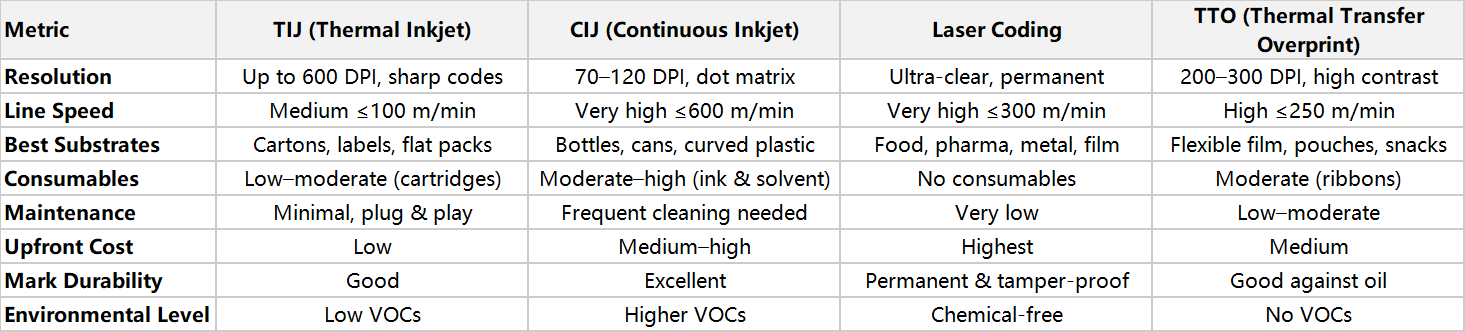
Essential Coding Technology Comparison
When evaluating coding technologies, it's crucial to understand their core strengths and limitations. Here's a quick comparison of the most common options:
| Technology Entity | Primary Substrate | Ink Type | Resolution (DPI) | Maintenance Difficulty |
|---|---|---|---|---|
| TIJ (Thermal Inkjet) | Paper, Cardboard, Non-Porous Films | Water-based and Solvent-based | 300-600 | Low |
| CIJ (Continuous Inkjet) | Almost All Substrates | Solvent-based | Variable | Medium |
| TTO (Thermal Transfer Overprinter) | Flexible Films, Labels | Wax/Resin Ribbon | 300 | Medium |
| Laser Marking | Metal, Glass, Rigid Plastics | N/A | High | Low |
Market Trends
The coding and marking industry is evolving rapidly in 2026. Key trends include:
- A shift towards sustainable, water-based inks to reduce environmental impact.
- Increased adoption of smart coding solutions that integrate with Industry 4.0 systems for real-time data tracking.
- Growing demand for high-speed, contactless printing to keep up with faster production lines.
Matching Technology with Packaging Substrates
The material you're printing on is the single most important factor in choosing a coding technology. Let's look at how different substrates perform with each option.
Porous Packaging
Best: TIJ (Thermal Inkjet)
Reason: Porous materials like paper and cardboard absorb ink exceptionally well. TIJ printers deliver crisp, fast-drying prints at high resolutions, making them ideal for these substrates. They also have low maintenance requirements, which is a plus for high-volume operations.
Non-Porous & Flexible Packaging
Best: CIJ (Continuous Inkjet) or TTO (Thermal Transfer Overprinter)
Reason: Non-porous films and flexible packaging don't absorb ink, so you need a technology that can adhere to these surfaces. CIJ uses solvent-based inks that dry quickly on almost any material, while TTO uses a heated printhead and ribbon to create durable, smudge-proof marks on labels and films.
Rigid Containers
Best: Laser Coding
Reason: Rigid containers like glass bottles, metal cans, and hard plastics are perfect for laser coding. Lasers create permanent, high-contrast marks without the need for consumables like ink or ribbons. This makes them extremely cost-effective over time, especially for products that require long-lasting identification.
Practical Application Cases
Case 1: Food & Beverage
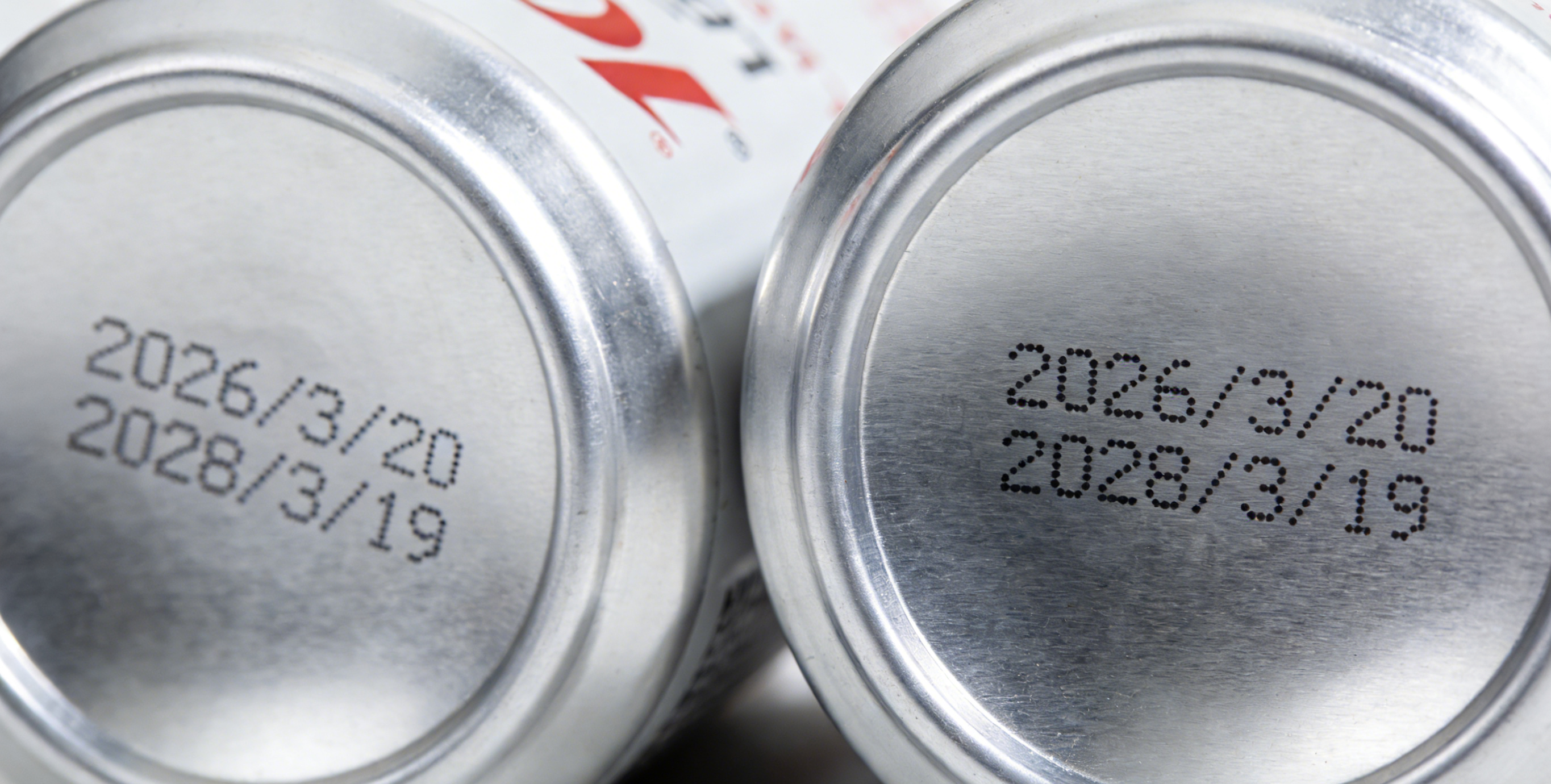
- Requirement: Printing expiration dates on 2,000 soft drink cans per minute.
- Solution: A high-speed CIJ printer is the ideal choice here. It can keep up with the production line speed, and the solvent-based ink adheres perfectly to the aluminum cans, ensuring the expiration date remains legible throughout the product's lifecycle.
Case 2: Pharmaceutical Serialization
- Requirement: Printing GS1 DataMatrix codes on small medicine boxes for serialization and traceability.
- Solution: High-resolution TIJ technology is commonly used to produce clear and scannable 2D codes on compact pharmaceutical packaging. These codes enable product authentication, supply chain tracking, and regulatory compliance. Reliable barcode quality is essential to ensure accurate scanning throughout distribution and retail environments.
Source: GS1 standards
Case 3: Craft Brewery
- Requirement: Print batch codes on the bottom of aluminum cans during small-batch production runs.
- Solution: For craft breweries with flexible production schedules, a portable solution such as a Handheld TIJ Printer allows operators to mark batch numbers directly on cans without installing a fixed coding system. This approach is cost-effective, easy to deploy, and ideal for small to medium production volumes.
Total Cost of Ownership Analysis
When choosing a coding technology, it's important to look beyond the initial purchase price and consider the total cost of ownership (TCO). This includes:
- Initial Investment vs. Consumable Cost: Laser printers have a higher upfront cost but no ongoing ink or ribbon expenses. TIJ and TTO printers are cheaper to buy, but you'll need to budget for regular ink and ribbon replacements.
- Downtime Impact: Technologies with lower maintenance requirements (like TIJ and Laser) can minimize production downtime, which is a significant cost savings for any operation.
In Conclusion
Choosing the right coding technology is all about matching your specific needs—substrate type, production speed, and budget—to the strengths of each available option. By carefully evaluating these factors, you can select a solution that not only meets your current requirements but also scales with your business in the years to come.
About the Author

Matty Chen is an Inkjet Application Engineer, and BENTSAI Inkjet Printing technology Consultant. He specializes in industrial inkjet printing technologies, with a focus on handheld printers, thermal inkjet systems, and coding solutions. His work explores ink performance, material compatibility, and practical printing applications for businesses across manufacturing, packaging, and product customization industries.
Handheld Inkjet Printers vs. Traditional Labeling Methods: Pros and Cons Analysis
Ask Question
No questions and answers

