Why Buy a Handheld Inkjet Printer? Top 6 Benefits & Industry Applications
Key Takeaways:
- Save time and labor: Print directly on products at their location. No walking to fixed printers, no waiting in line.
- Cut material costs: Eliminate adhesive labels entirely. Direct-to-surface printing removes recurring label expenses.
- One device, many surfaces: Works on cardboard, plastic, metal, wood, fabric, and curved containers with the right ink.
What is a Handheld Inkjet Printer?
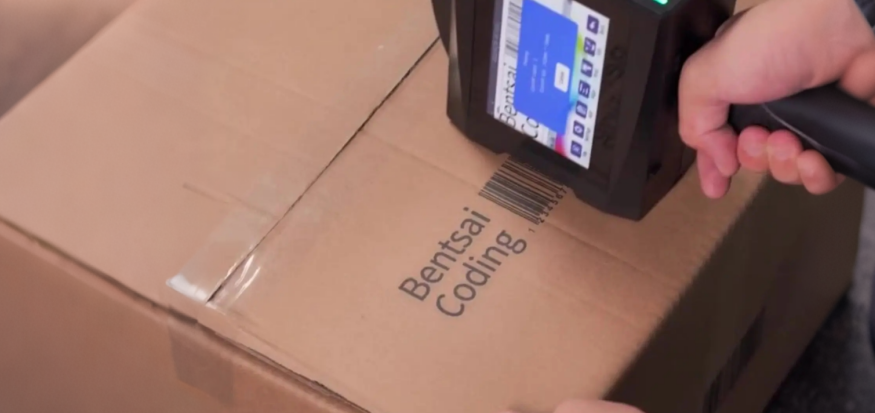
A handheld inkjet printer is a portable, battery-powered device that prints text, barcodes, dates, and logos directly onto products or packaging. Unlike stationary printers that require items to be brought to a fixed location, handheld inkjet printers go where the work is—whether that's a warehouse shelf, a loading dock, or a production line.
Top 6 Reasons Businesses Buy Handheld Inkjet Printers
1. Portability for On-the-Go Batch Coding
Fixed printers chain workers to one spot. Handheld printers free them. A worker can walk to a pallet, print batch numbers on every box, and move to the next location—all without returning to a central station. This eliminates hundreds of hours of walking time annually. For warehouses with multiple labeling points, the productivity gain is immediate.
2. Versatility on Porous vs. Non-Porous Surfaces
Handheld inkjet printers break the mold of conventional printing by being able to print on a variety of surfaces. Be it metal, wood, fabric, plastic, or even uneven and textured surfaces, these printers handle it all with ease. This versatility makes them a perfect fit for diverse printing needs, from industrial labeling to creative design applications. The key is matching the right ink to the surface—water-based for porous materials like wood and cardboard, solvent-based for non-porous surfaces like plastic and metal.
3. High-Resolution Printing
At 300 to 600 DPI, handheld inkjet printers produce sharp text and scannable barcodes that rival stationary systems. This matters for compliance: FDA regulations, retail partner requirements, and internal tracking all depend on codes that scan on the first attempt. Low-resolution printing leads to misreads, chargebacks, and rework. High-resolution eliminates those problems.
4. Cost-Effectiveness & ROI vs. Traditional CIJ
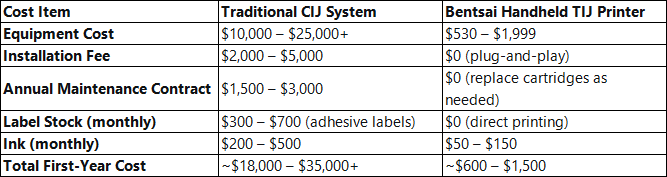
Continuous Inkjet (CIJ) systems often cost $10,000+ upfront and require regular maintenance contracts. Handheld thermal inkjet (TIJ) printers start at a fraction of that—often under $1,000—with no installation fees. The ongoing savings are just as significant. Adhesive labels cost $0.03 to $0.07 each. A facility printing 10,000 labels monthly spends $3,600 to $8,400 annually just on label stock. Handheld printers eliminate that cost entirely by printing directly on boxes and products.
5. Eco-Friendly Ink Cartridge Options
Handheld printers reduce waste in two ways. First, they eliminate adhesive labels and their silicone-coated backing paper—both of which go to landfills. Second, many models use refillable ink cartridges instead of disposable printheads. Water-based inks contain fewer volatile organic compounds (VOCs) than solvent-based alternatives, making them suitable for food packaging and indoor use.
6. Ease of Use
Quick setup, straightforward operation, and the ability to print with precision make handheld printer guns a user-friendly choice for both professionals and hobbyists. Most models feature touchscreen interfaces, pre-saved templates, and USB file transfer. A new worker can learn to print date codes and barcodes in under 15 minutes. No specialized training required.
Common Industry Applications for Portable Printers
- Food & Beverage: Print expiration dates, best-by dates, and batch numbers directly on dairy cups, meat trays, frozen food boxes, and produce bags. Eliminates label peeling caused by condensation.
- Logistics & Warehousing: Generate QR codes and barcodes on shipping boxes at the point of packing. Workers print on site instead of walking to a centralized label station.
- Manufacturing: Mark lot codes, serial numbers, and part identifiers on metal brackets, plastic housings, rubber seals, and wooden pallets. Marks survive oil, heat, and abrasion.
Frequently Asked Questions
1. Can handheld inkjet printers print on glass or plastic?
Yes. With fast-dry solvent ink, handheld printers adhere to glass, plastic, metal, and coated surfaces. The ink dries in 2-5 seconds and resists smudging. For best results, clean the surface before printing to remove dust or oil.
2. What is the difference between water-based and solvent ink?
- Water-based ink: Absorbs into porous surfaces like paper, cardboard, untreated wood, and fabric. Eco-friendly, low odor, and economical. Not recommended for plastic, glass, or glossy coatings.
- Solvent ink: Bonds to non-porous surfaces like plastic, glass, metal, and coated boxes. Dries quickly, resists moisture and abrasion. Required for challenging industrial environments. Has a stronger smell than water-based ink.
Conclusion
Handheld inkjet printers solve real problems: wasted walking time, expensive label stocks, and inflexible equipment that can't handle multiple surfaces. They deliver portability, versatility, high resolution, cost savings, eco-friendly operation, and ease of use. For food packers, warehouse operators, and manufacturers, switching from stationary printers or pre-printed labels to handheld on-demand printing delivers measurable ROI—often within months.
About the Author

Matty Chen is an Inkjet Application Engineer, and BENTSAI Inkjet Printing technology Consultant. He specializes in industrial inkjet printing technologies, with a focus on handheld printers, thermal inkjet systems, and coding solutions. His work explores ink performance, material compatibility, and practical printing applications for businesses across manufacturing, packaging, and product customization industries.
Ask Question
No questions and answers

