The Ultimate Guide to Handheld Inkjet Printers in Manufacturing (2026 Data)
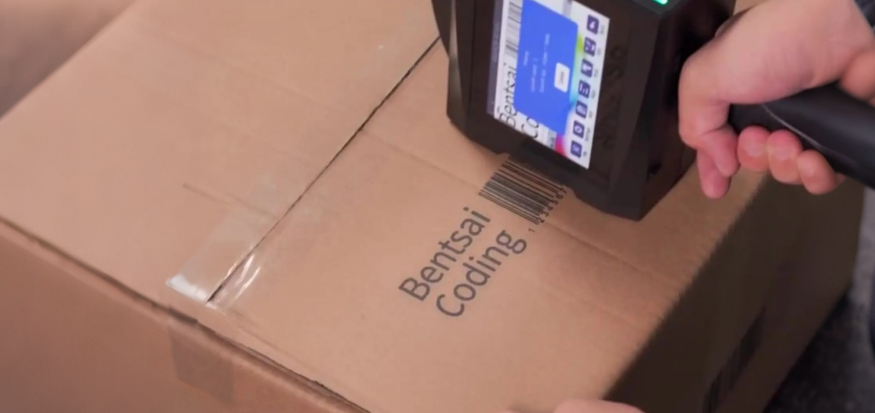
A handheld inkjet printer is a portable, battery-powered device that prints variable data—barcodes, serial numbers, batch codes, and logos—directly onto products, parts, or packaging at their location. Unlike fixed printing systems that require items to be brought to them, these mobile devices go where the work is.
For a full range of handheld printers, explore the complete product lineup.
Key Takeaways
- ROI: Handheld thermal inkjet (TIJ) printers offer significantly lower upfront costs ($530–$2,199) compared to continuous inkjet (CIJ) systems ($8,500–$22,000). With no installation fees, minimal maintenance, and no adhesive label expenses, manufacturers typically see payback within months, not years.
- Main Applications: From marking metal parts and plastic components to printing batch codes on food packaging and barcodes on shipping cartons, handheld printers handle traceability, compliance, and branding across the factory floor.
- Ink Compatibility: Matching ink to surface is essential. Water-based inks work on porous materials (wood, cardboard, uncoated paper). Fast-dry solvent inks are required for non-porous surfaces (plastic, glass, metal, coated packaging).
The Financial Impact: Why Manufacturers are Replacing CIJ and Pre-Printed Labels
The global portable handheld inkjet printer market was valued at $1.30 billion in 2025 and is projected to reach $2.06 billion by 2032, growing at a CAGR of 6.84%. Why the surge? Manufacturers are discovering that handheld TIJ printers eliminate two major cost centers: expensive CIJ maintenance and wasteful pre-printed labels.
Lower Total Cost of Ownership (TCO)
The cost difference between CIJ and TIJ is substantial:
| Cost Category | CIJ System | Handheld TIJ (Bentsai) |
| Equipment Cost | $8,500–22,000 | $530–2,199 |
| Installation | $2,000–5,000 | $0 (plug-and-play) |
| Annual Maintenance | $1,500–3,000 | $0 (replace cartridges only) |
| Cost per 1,000 prints | $0.30–0.60 | $3.00–5.00 |
| 5-Year Operating Cost | $11,400–26,800 | $13,000–21,500 |
Data compiled from industry cost analyses.
While CIJ has a lower cost per print for high-volume, 24/7 production, handheld TIJ printers are more cost-effective for short runs, seasonal production, and multi-line facilities where frequent changeovers are required. For small to medium manufacturers, the lower entry cost and minimal maintenance make handheld printers the clear winner.
Eliminating Adhesive Label Waste
Adhesive labels carry hidden costs: the label stock itself, the silicone-coated backing paper that goes to landfill, and the labor to peel and apply each one. A facility printing 10,000 labels monthly spends $3,600–$8,400 annually just on label material.
Handheld printers eliminate that entirely. Direct-to-surface printing marks cardboard, plastic, metal, and wood with no consumable label. This not only saves money but also reduces waste—a growing concern for manufacturers with sustainability targets.
Core Entity Attributes and Technical Specifications
Bentsai handheld printers are built for the factory floor. Here are the key specs:
- Print Technology: Thermal Inkjet (TIJ) – heat-driven drop ejection from cartridges. Lower maintenance than CIJ, with no pumps, filters, or solvent makeup required.
- Print Resolution: Up to 600 DPI. This ensures sharp text and scannable barcodes—critical for traceability and compliance. CIJ typically offers lower resolution (dot-matrix style).
- Print Height: Ranges from 2.5mm to 92mm depending on model. The B85 wide-format printer supports up to 40 lines of text in a single pass.
- Ink Compatibility: Supports both water-based (porous surfaces) and fast-dry solvent (non-porous surfaces) inks. The choice depends entirely on your packaging material.
- Connectivity: USB for file transfer. Load batch numbers, serial codes, and variable data via USB drive. Some models also support Wi-Fi for wireless file transfer.
Practical Application Examples in Modern Manufacturing
- Metal Parts & Components: Print serial numbers, part codes, and QR codes directly on metal brackets, pipes, and housings. Solvent-based ink ensures marks survive oil, heat, and abrasion.
- Plastic Packaging & Components: Mark batch codes and expiration dates on plastic bottles, tubes, and molded parts. Fast-dry ink adheres without smudging.
- Food & Beverage Packaging: Apply "Best By" dates, batch codes, and traceability information on cartons, pouches, and trays. For more on food packaging printing, see our industry guide.
- Wood Products & Lumber: Stamp grade stamps, moisture content, or production dates on wooden pallets and crates. Water-based ink absorbs without bleeding.
Choosing the Right Ink for Your Production Line
Water-Based vs. Fast-Dry Solvent Inks
The rule is simple: match the ink to the surface.
- Water-Based Ink: Absorbs into porous surfaces like paper, cardboard, untreated wood, and fabric. Eco-friendly, low odor, and economical. Not suitable for plastic, glass, or glossy coatings.
- Fast-Dry Solvent Ink: Bonds to non-porous surfaces like plastic, glass, metal, and coated cartons. Dries in 2–5 seconds, resists moisture and abrasion. Required for challenging industrial environments. Has a stronger odor than water-based ink.
Picking the wrong ink leads to smudged codes, unreadable barcodes, and compliance failures. Always test your ink-surface combination under real production conditions.
Frequently Asked Questions
Q1: How long does a handheld printer battery last on a shift?
Bentsai handheld printers offer 8–10 hours of continuous use on a full charge, depending on the model and printing frequency. The B85 features a 6000mAh battery, while smaller models typically run 8+ hours. Overnight charging restores full capacity.
Q2: Can handheld printers integrate with automated conveyor belts?
Yes. Bentsai printers can be mounted on a stainless steel bracket with a photoelectric sensor. When the sensor detects a package passing, the printer triggers automatically—no manual intervention needed. This hybrid approach gives you manual flexibility plus automated efficiency when you need it.
About the Author

Matty Chen is an Inkjet Application Engineer, and BENTSAI Inkjet Printing technology Consultant. He specializes in industrial inkjet printing technologies, with a focus on handheld printers, thermal inkjet systems, and coding solutions. His work explores ink performance, material compatibility, and practical printing applications for businesses across manufacturing, packaging, and product customization industries.
Ask Question
No questions and answers

